The garden and I both look like we could use a break, I think. A nap, a slumber. Good for the garden, because it’s almost time for it to settle down and sleep for the winter. No such luck for me.
This month has been a *lot*, most of which I can’t or shouldn’t get into here, but I’ll say a highlight was getting to go to a concert with some friends for the first time in a literal decade (even if it was a sensory nightmare, and I left a little over halfway through – totes worth it for the first half, and the dinner beforehand), and I had a lovely time volunteering at the nature festival I mentioned last month.
Anyway, a brief entry, as I have only just started this at 9:30pm on the last day of the month, and the cats and my physical need for sleep are going to cut my time [for writing] short well before midnight:
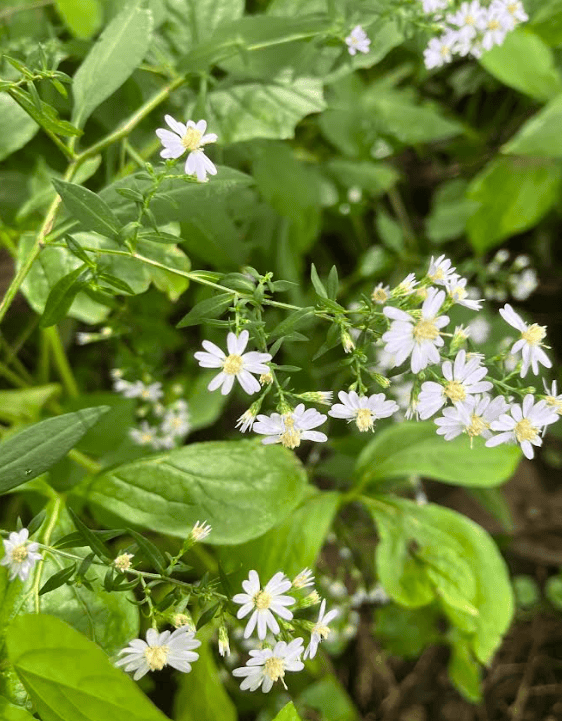
A few native plants I’ve seeded in the last year or two have showed up in force this fall. There was a brown eyed susan I didn’t get a picture of, but this little wood aster was a welcome newbie to our yard:
So dainty, so cute!
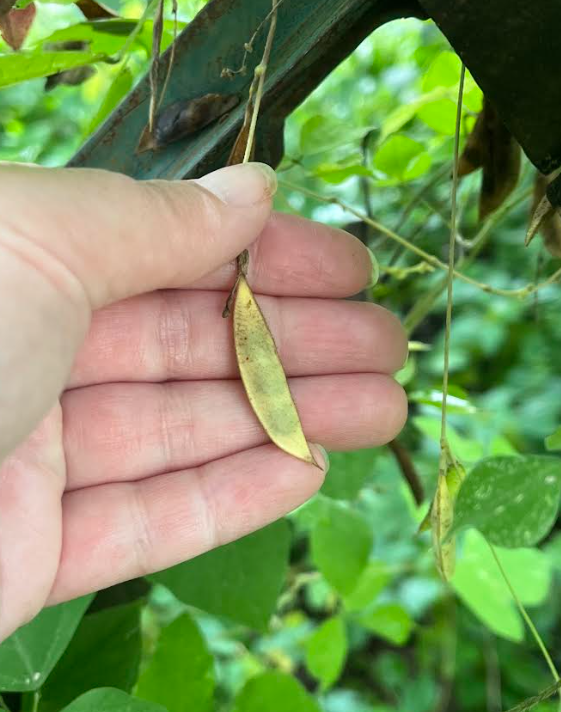
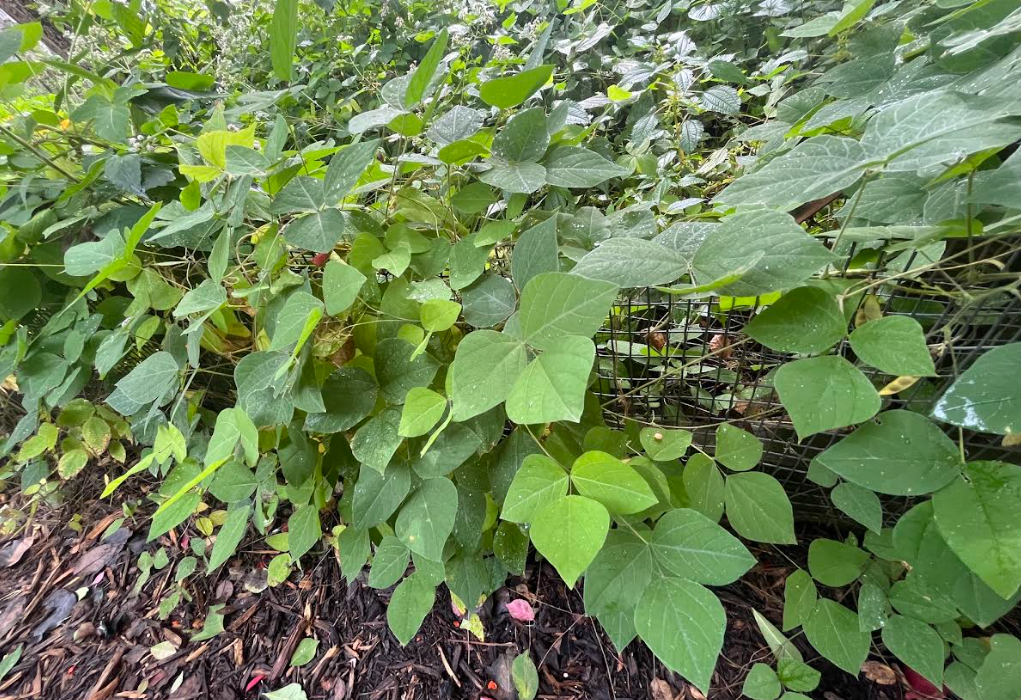
My little mousebean army really produced this year. I had really wanted to harvest a bunch to cook at some point, but it didn’t happen, although I did eat a few underripe ones fresh – they had a very pea-like flavor to them.
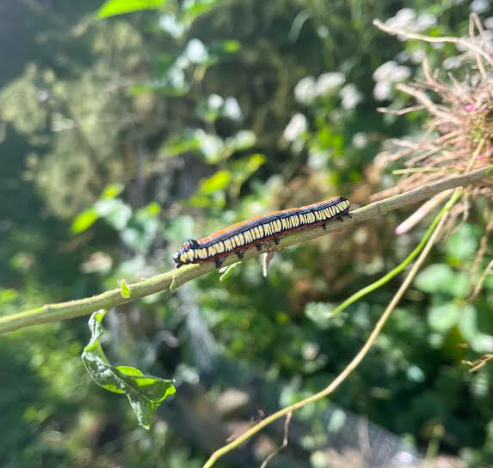
In cool bug territory, I came across a couple of these Brown-hooded Owlet caterpillars while I was pulling some of the over-enthusiastic goldenrod that’s been running amok. (Don’t worry, I put the stems down near the rest of the goldenrod so they had easy access to more food if they needed it, although they were big enough that I think they might have been getting ready to coccoon.)
I feel like I’m doing a poor job showing off how cool these are – their colors are really bright and dramatic.
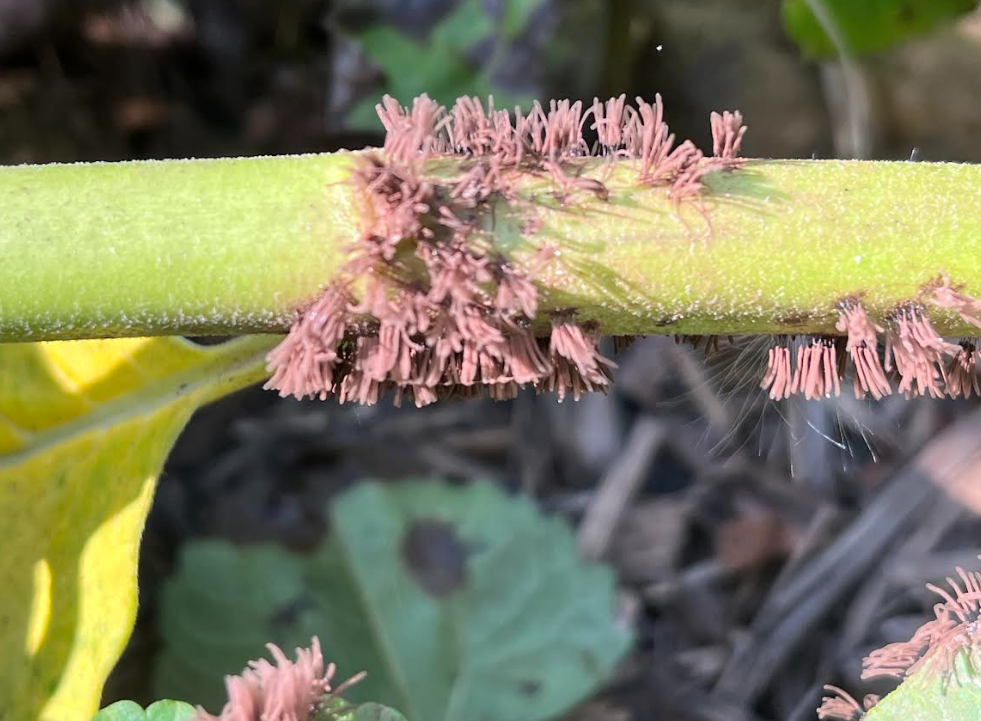
There’s a couple of slime molds that really love the wood chip mulch we use in the garden, I’m always weirdly delighted to see a Stemonitis, the chocolate slime mold, crawl up onto the plants:
Don’t worry about the plant; the slime mold just climbed up onto it to sporulate so the spores can be spread by the wind. They’ll be gone soon enough, no damage done to the plant.
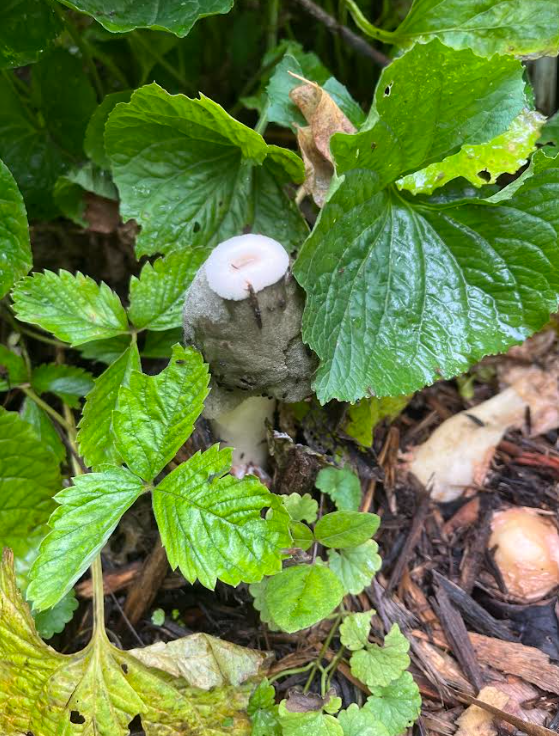
And of course, would it really feel right for there to be a rainy fall in the garden without a sad-dick-looking Phallus sp. stinkhorn showing up? ….I mean, yeah it’d be fine, they smell weird and they’re a little gross, but they’re at least kinda fun-weird, they’re not hurting anyone really, and they’ll be gone soon enough.
Phallus impudicus, I’ll let you write your own jokes.
That’ll have to do for now. Here’s hoping for a more relaxed October, and hopefully I’ll be back with photos of our late raspberries in a few weeks.
I’ll preface this by saying that it’s been a good month, but something about August always feels like a struggle to me. I think it’s mostly the corn sweat-driven humidity and resulting heat indexes; it’s just an unpleasant time to be outdoors, and unless you have adequate dehumidification, it’s not great indoors either. This particular August also wound up being quite a busy month for me at work, as I’m taking over responsibilities for a departing colleague. We also hosted my partner’s family for a weekend, which was very fun, but required some thought, preparation, and energy. To ensure I had enough spoons to wrangle the previously listed items, I’ve had to let some other things slip, chief among them the garden. As a result it has developed into a wild, green snarl. I’m still harvesting a steady stream of cherry tomatoes and green beans, and the occasional bell pepper, and I’ve tried to pull some of the more annoying invasives, but it feels a bit like a lost cause at this point.
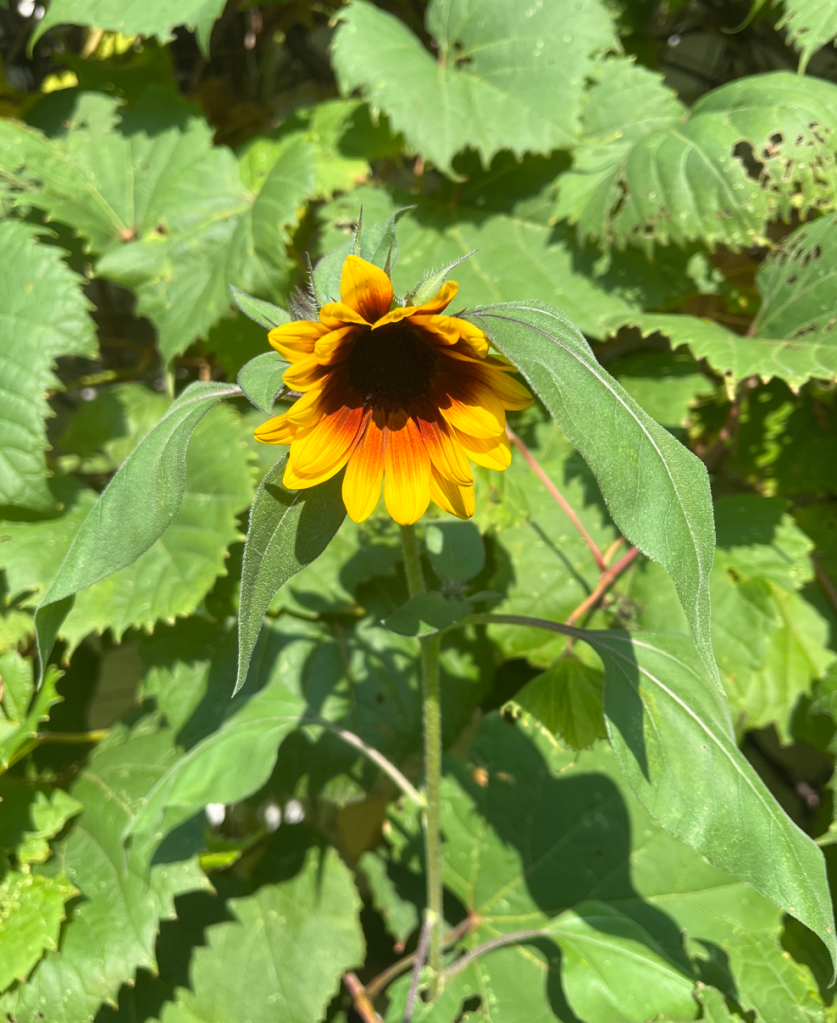
We did have a volunteer sunflower show up next to our grapes that bears a suspicious resemblance to some of our neighbors’ sunflowers, so I’m guessing the seed was a gift from our local squirrels. Nice to have an assistant gardener, I guess?
The grapes themselves are starting to ripen, so assuming the aforementioned squirrels don’t eat them all, maybe we can make some jam next month.
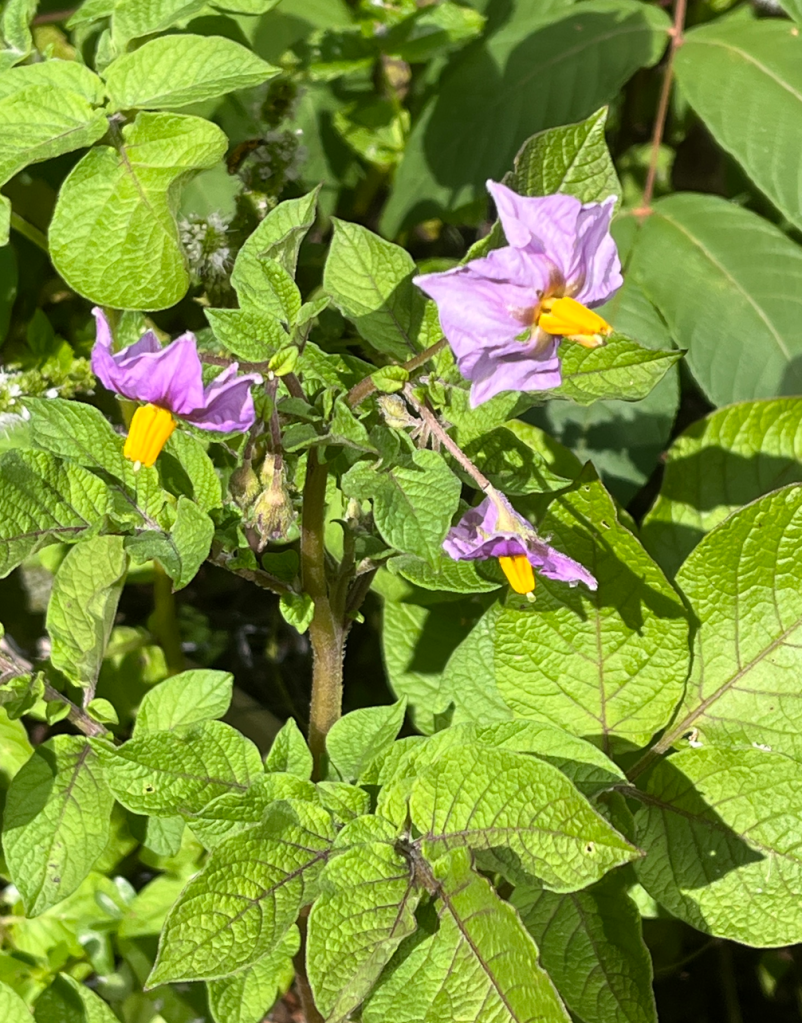
The potato seeds I planted pretty late in the season have nonetheless come up and the plants are now blooming, so now I’m kinda hoping I can get some more seeds and grow a proper crop of them next year. In the meantime they have surprisingly big, purple flowers that just scream “HELLO, I AM A NIGHTSHADE!” that I am very fond of.
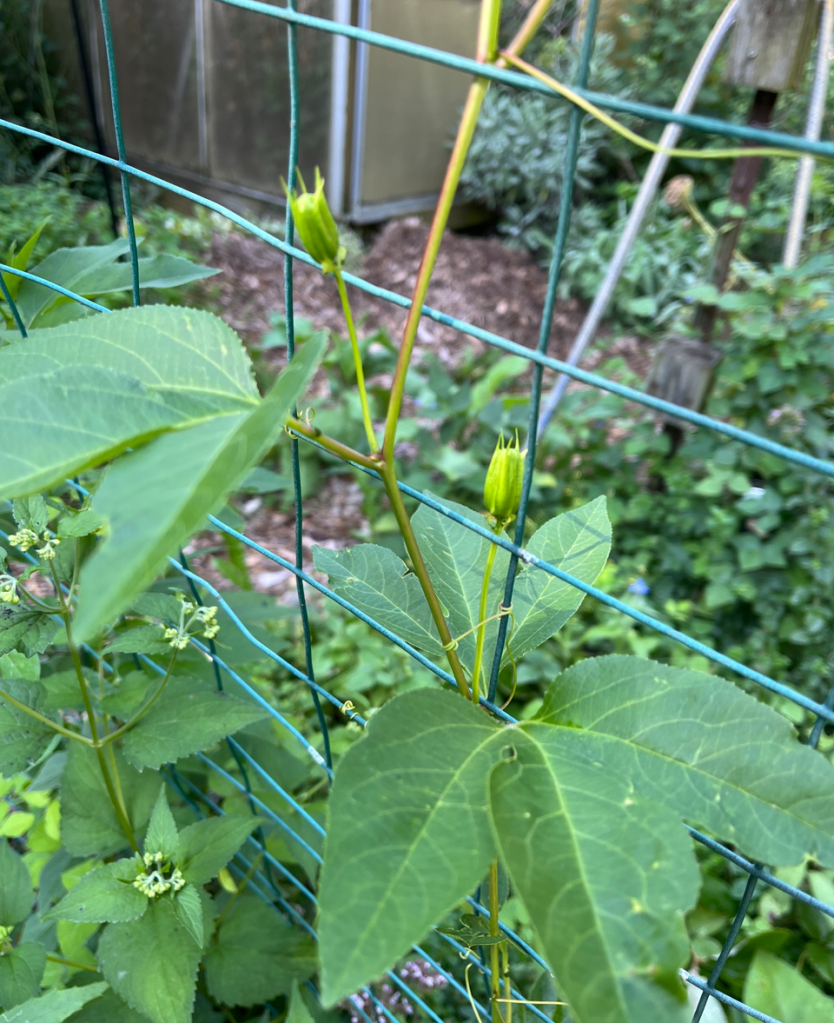
The maypop vines are doing *quite* well; one of them is approaching my height, and has some flower buds that are coming along nicely. I’m not positive they’ll beat the first frost, but it’ll be a lovely surprise if they do.
I have made a conscious effort to do a bit more wild foraging and naturing this year, or at least a bit of foraging reconnaissance. I haven’t done much since we moved into our current place in 2021, and while I’ve clearly had enough nature to wrangle in the yard, it’s not really the same as exploring new places, searching for different plants, or getting acquainted with different ecosystems.
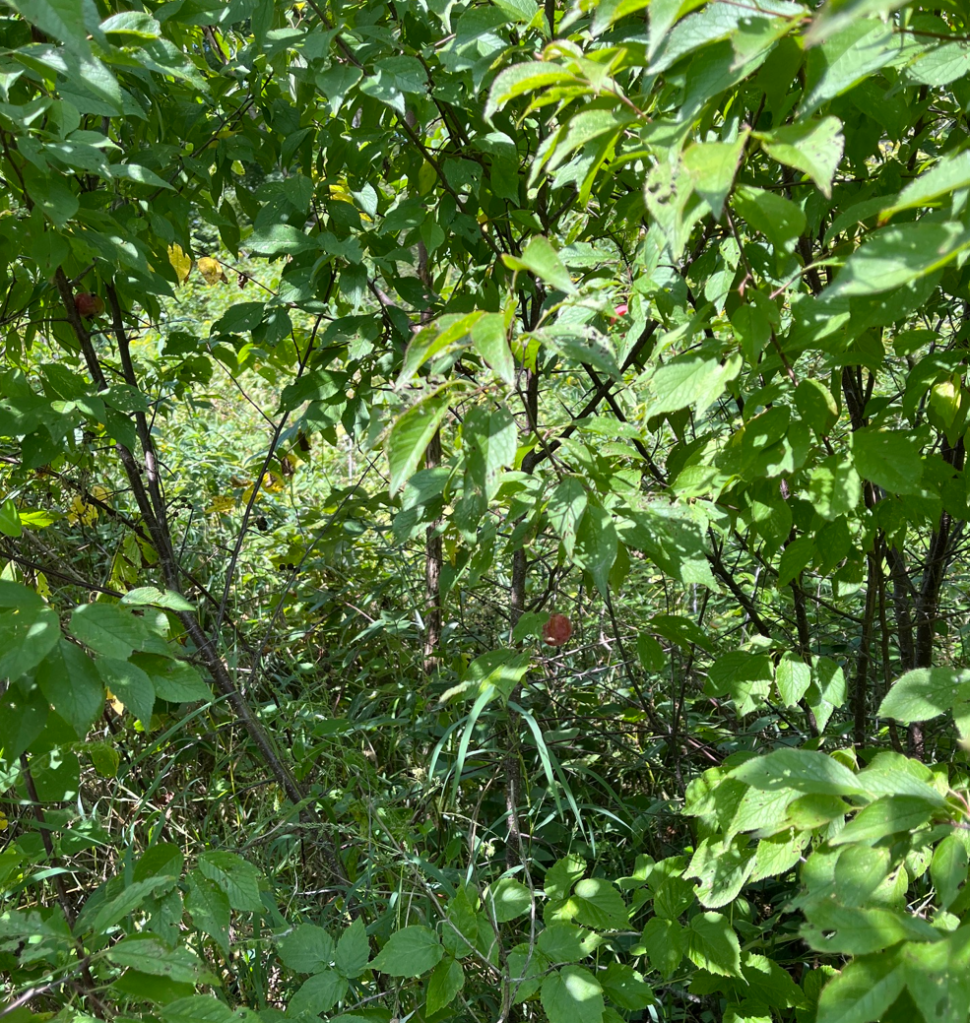
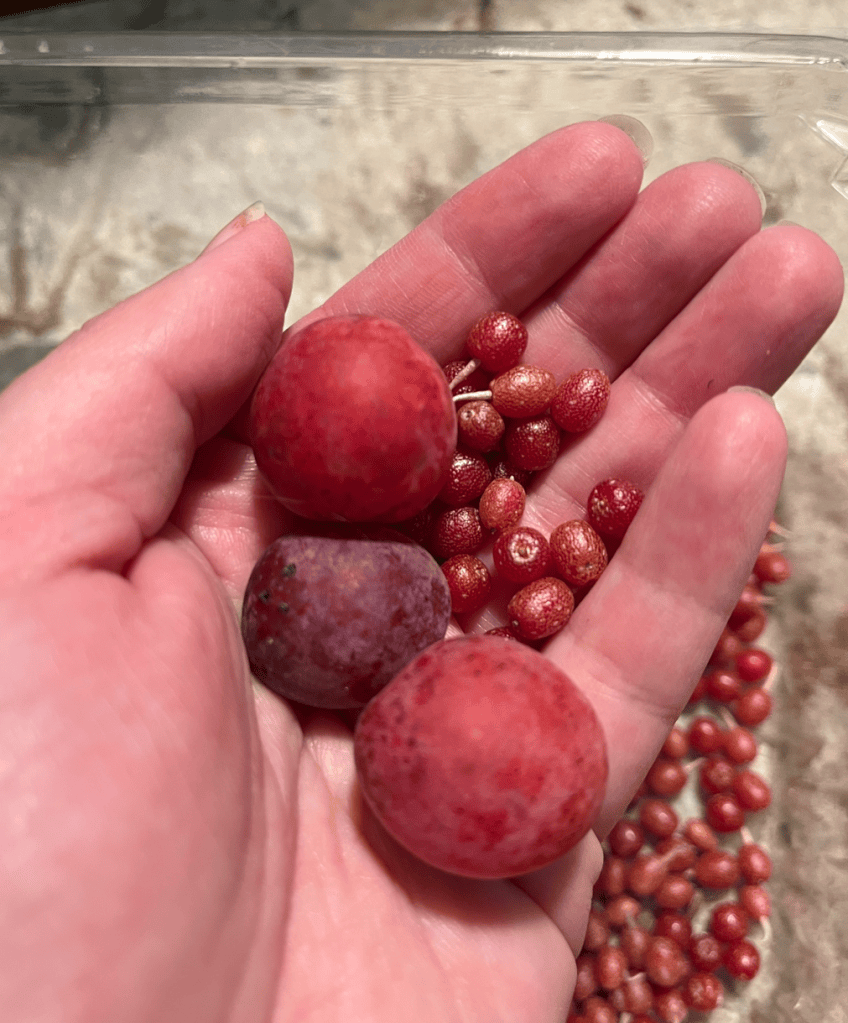
This month, I returned to a site near Lodi that I haven’t been to for a few years, where I have previously picked wild plums. Our native plums are quite small – the size of a large grape, maybe – and quite sweet, with skins that are sharply sour and tannic. I wasn’t optimistic that about finding them because of the late freeze that wiped out our backyard plum harvest, but I found a few! Not sure exactly why there were so few, because it could have been the freeze, or that I caught them late, or that they were heavily grazed on already (especially because they’re so close to a reasonably well travelled trail), but I just picked three for a taste, and to get a few pits for planting.
There are at least two plums in this picture. If I didn’t know exactly what I was looking for I’m sure I’d have waltzed right past them.
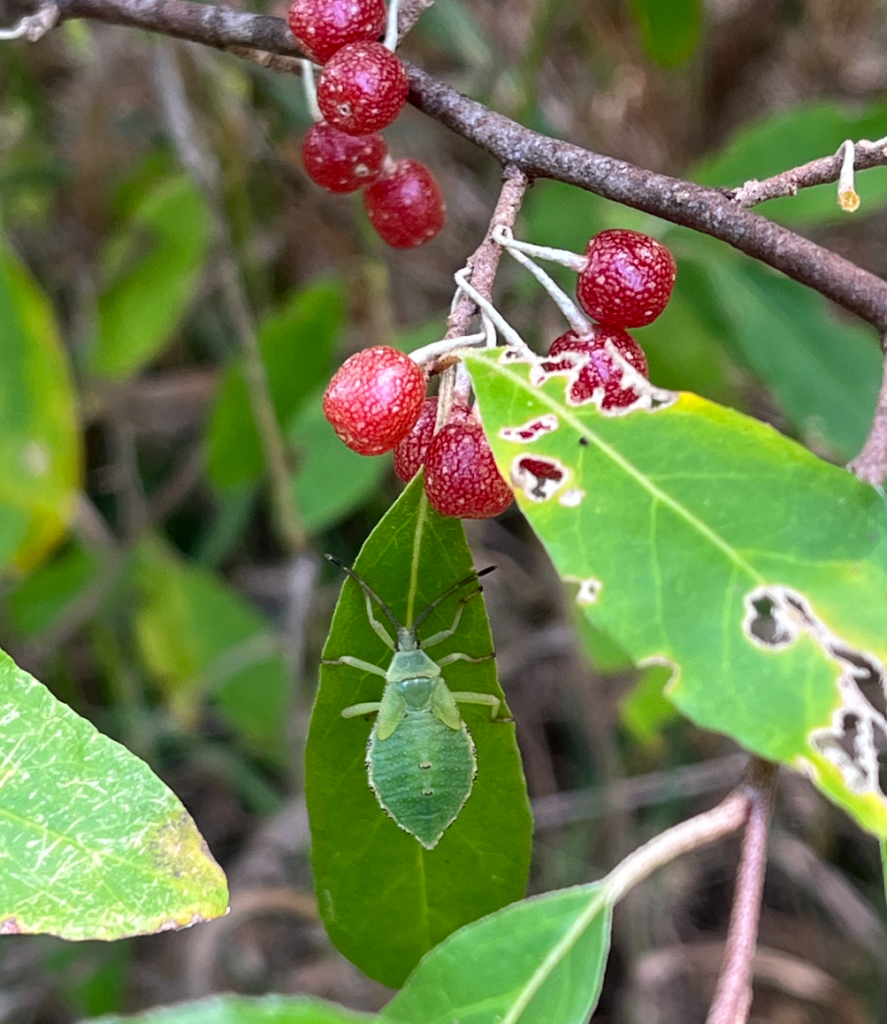
While I was there I noticed some red berries on a shrub, which turned out to be autumn olive, an invasive bush that was widely planted for erosion control before it was understood how disruptive and destructive it could be. I think I remember identifying them at the site previously, because they have distinctive silvery foliage, but this is the first time I’ve encountered their ripe berries (or at least the first I’ve found them and recognized them), and I picked a bunch. They’re described in a lot of introductory guides to foraging and I’ve seen a ton of photos of them, but I was caught off guard by how small the berries are in person. They’re also about 90% seed by volume, so I’m going to try to maybe make a little compote or something with them that I can run through a food mill.
Autumn olive with its silver speckles, with a guest appearance by Green Stink Bug.It wasn’t a particular bountiful forage, but it was fun!
I was going to write a bunch about insect abundance, and how I’ve been consistently weirded out by the relative dearth of at least some of the more obvious flying insects in my area as compared to past years, and how that’s been backed up by what I’ve read in a lot of gardening groups on social media…but it’s just so hard to extrapolate from a data set that consists primarily of vibes, and I am trying to resist the urge to wallow in my anxieties about the polycrisis.
Instead, I’ll just say that things are pretty good for me at the moment, and I’m looking forward to volunteering at a nature festival in couple weeks, to my partner’s upcoming birthday, and to venturing forward into fall, my favorite season.
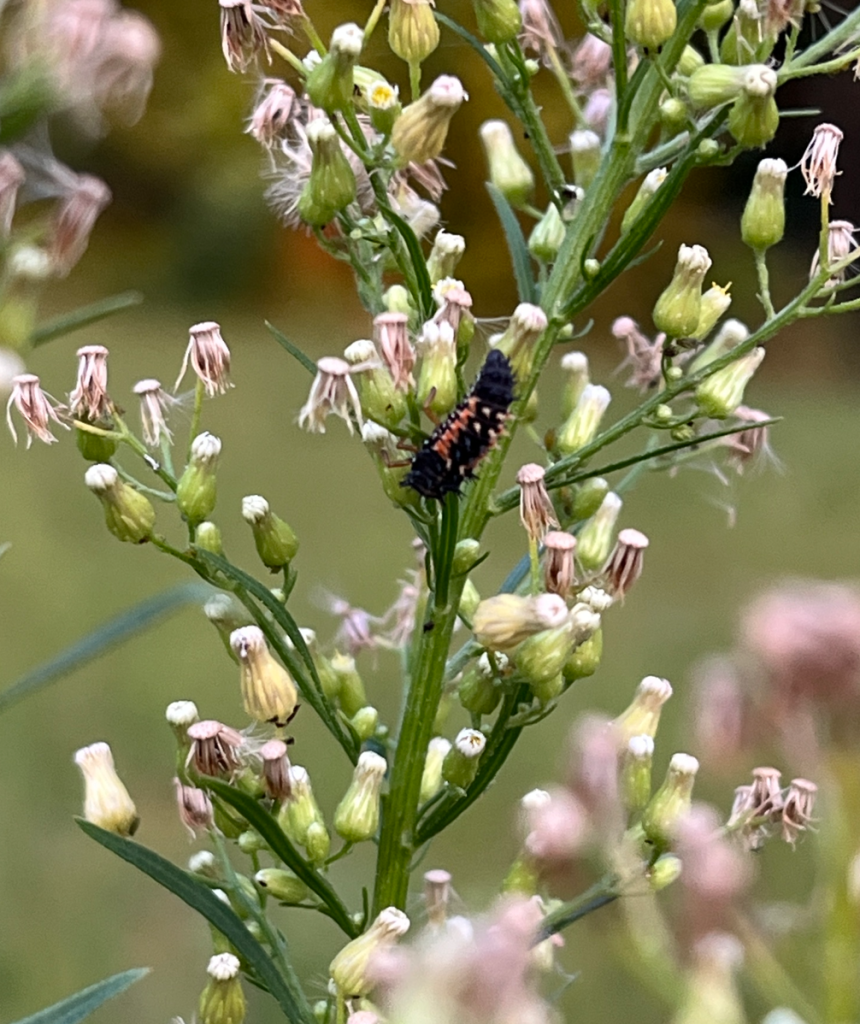
I think of ladybug larvae as being little aphid-eating crocodiles, because….that’s kinda what they look like right?
This month has seen the police execution of Corey Ruiz, the devastation of Menasha by a tornado that hit with 2 minutes of warning, the acceleration of massive wildfires on at least three continents (probably more?), the expansion of the war in Iran, rapid growth of an uncontrolled ebola epidemic, and a general torrent of horrifying news regarding politics and climate. So, this meme has felt more applicable than ever:
Mild disassociation has gone a long way towards keeping me upright and moving forward in spite of both the above factors as well as some minor-but-persistent-and-frustrating health issues. On the plus side, the air quality issues caused by drifting wildfire smoke did not keep me indoors nearly as many days as I was afraid they might. Nothing like the smell of burning plastic to make you appreciate the day it goes away.
Anyway, I’m lingering on the horrors, which are certainly present, but I don’t really want to talk about them right now. Let’s see some bugs instead.
Bombus sp. on musk mallow (I think)Bombus sp., on prairie coneflowerSweat bee on oreganoBlack digger wasp on oregano
The oregano is, as it has been in past years, extremely popular amongst a wide array of bees, wasps, and others.
Bombus on oregano. Everyone loves oregano!
There has been the usual steady stream of white cabbage butterflies which, no shade to them, are so ubiquitous that I rarely bother photographing them. The less abundant lepidopteran visitors have included a handful of little azures that have been difficult to snap pics of, as well as the occasional hairstreak and monarch, and (thusfar) one fritillary.
Hairstreak of some variety, on common milkweedMonarch on common milkweedFritillary on coneflower; I think this is a species whose larvae eat wood violet leaves, which would explain why my yard might be attractive to them, aside from the food sources for adults
In addition to putting out water for birds and mammals, I also put out a container specifically for pollinators, with rocks to climb on so they don’t drown. What I envisioned as sort of a watering hole for many insects, however, has pretty much turned into a wasp bar. I’m fine with this – I bear them no ill will, they have an important role to play both in nature and in controlling many garden pests – it was just a surprise to me that I have only *ever* seen wasps in it, since I set it out. I am now considering making a tiny sign for them. If you have any clever names for wasp bars, let me know.
They lack the charisma of their cousins in Bombus and assorted other bee groups, but they are sharp dressers and take no shit, and I admire that.
As you can see, it’s busy out for the inverts. It’s also busy out for the flora (and everything else); this is the start of the season where everything sort of explodes and I just do my best to keep the super aggressive things from getting too out of hand.
Cutleaf coneflower absolutely exploding back behind the garageGentians, coneflowers, joe pye weed, and friends
The edible portion of the garden has been trucking along; the periods of intense heat have slowed down some of the things like tomatoes and peppers, but they’re recovering in the cooler periods, and we’re getting a slow but steady drip of cherry and spoon tomatoes.
Currant tomatoes, Solanum pimpinellifolium, considered the ancestor of the domestic tomato
The japanese beetles, after a quiet year or two, seem to have exploded this summer. I spent a lot of time manually plucking them off the grape vines and plum trees and throwing them into cups of soapy water, a form of bug murder that was somehow cathartic in a way I don’t want to interrogate too much.
Japanese beetles did a number on the foliage, but they’re still looking pretty good overall; here’s hoping the mammals don’t strip all the fruit off before we can pick it
I bought some hardneck garlic from Keene’s a few years ago, which was a great investment. The garlic continues to do fantastically, providing both scapes and bulbs. I left a few heads in the ground because I wanted to let a couple scapes fully mature and try planting the bulbils, and I’ll nab some of the biggest bulbs to take apart and replant later this year, but this still leaves a nice supply of fresh garlic for us to eat and share.
Many garlics!
The green beans have also finally taken off; I always seem to forget how long it takes them to get rolling, and stress about them not germinating/blooming/etc., and this year that resulted in me planting…maybe more than I would have otherwise? But that’s okay! The snap peas were pretty much a bust, so it’s nice to have something that vaguely fills a similar set of culinary roles. And, my primary reason for growing produce is to have awesome fresh, crisp, tasty veggies for us, and in my opinion green beans straight from the garden are one of the best low-fuss, low-effort payoffs around. I’m harvesting a heaping handful of beans a day for the moment, which doesn’t sound like a ton, but they ramp up quickly, and I’m guessing we’ll have at least a couple gallon freezer bags full at the end of the season.
Many beans, such green
The pawpaws, hazelnuts, and maypop vines I put in this spring all seem pretty happy and healthy, which is exciting to see. In particular I thought the maypops might just keel over on me, but they are climbing happily and seem to be doing well despite the heat.
Maypop, annual vine; its native range ends just a bit south of here, in the northern parts of Illinois, but I’m hoping that between climate change, the sheltered nature of the back garden, and a little babying, it’ll be able to thrive here.
So, that’s what’s been keeping me busy, happy, distracted. It’s a rainy day today, and my day off, so I’m going to spend some extra quality time with the kitties, and attempt to absorb some of their zen.
Peppermint’s little dead bug sleeping pose is always a worth a jolt of dopamine
Spring progresses, slipping prematurely into summer at times. The jagged progression of temperatures has had some casualties; in particular, due to a late freeze in April, I think we lost our entire plum crop and 95%+ of the pears. On the bright side, I guess, I am not having to spend any time culling tiny pears, and the ones that do make it will likely be larger. In previous years we’ve had issues with how absurdly productive the trees are – with branches breaking under their weight – so it’s also probably a good thing for the trees to have a year off. It’s a bit of a bummer, to be sure, because we and so many people around us look forward to those pears every year, and they have been SO very reliable in the past. It feels like a pointed reminder of the fragility of the systems we depend on, including agricultural ones, and the necessity of both redundancy and diversity.
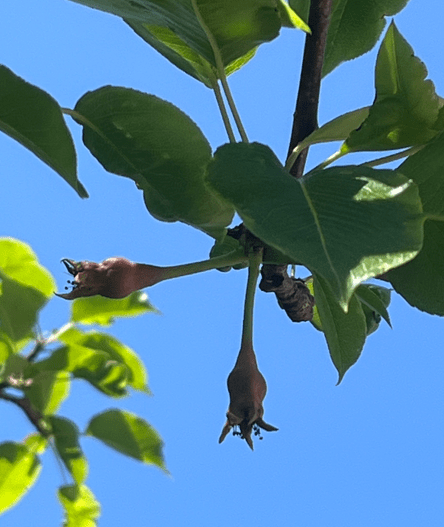
A couple of the surviving bebeh pears. Good luck, bebeh pears!
In fact, it is looking like it’ll be a better year for some of our other fruits, although not in sufficient volumes to compensate for the pears. The black raspberries are coming along nicely; I’m not convinced we’ll be at “pie” volumes yet, but I think we’ll at least graduate from “eat three berries and be glad for it” to “eat a few handfuls of berries apiece” territory. Our honeyberries have also really started taking off; the bushes are looking flush and healthy, and I’m regretting not giving them more space. Looks like they might be sending up some suckers so I may be able to spread out their clones, at least. We were not very impressed with the couple of extremely sour berries we tried last year, but I have since learned that we likely picked them far too early; apparently you’ve supposed to give them a good 3-4 weeks after they turn dark blue, and only pick them once they’re just about falling off the plant, and the flesh inside the berry has turned from green to blue. I’ll report back next month, since they’ve started cascading into blues this week.
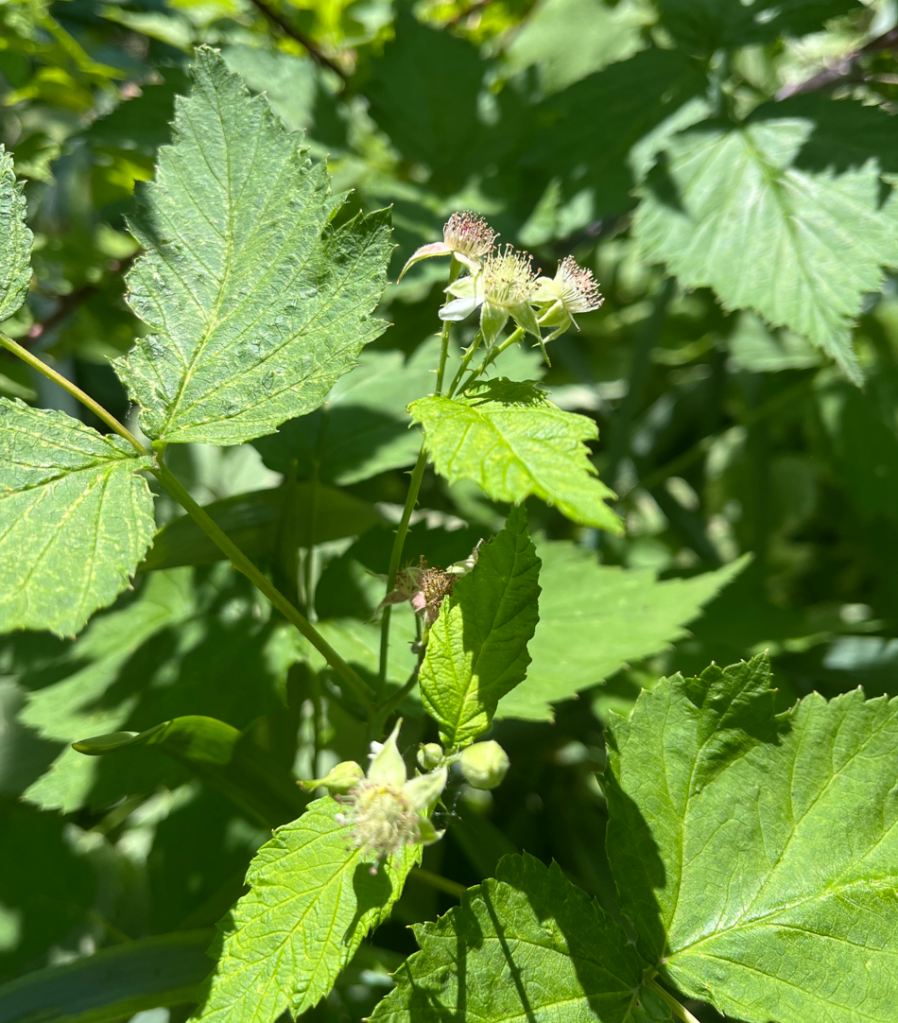
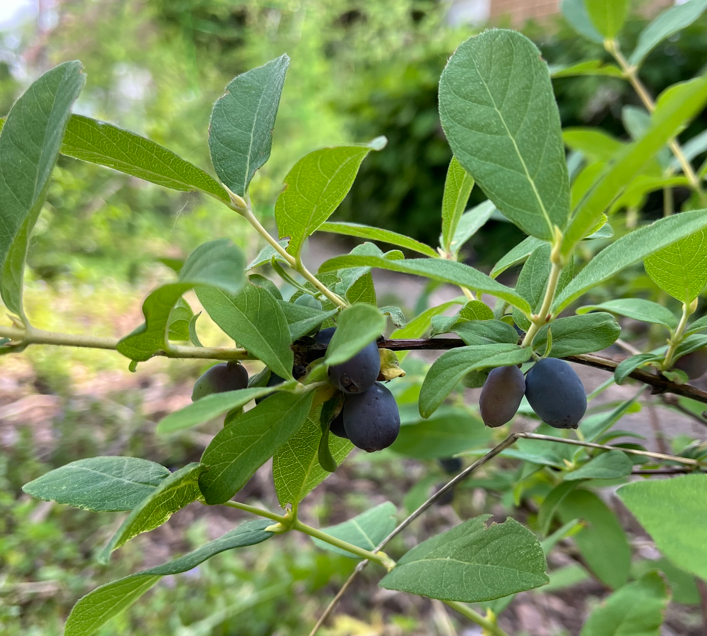
Black raspberry flowers, looking good!Honeyberries, aka haskaps! Not locally native, but at least they’re from this continent.
The strawberries – many of which were plants recovered from a dumpster last year when entire trays of them were tossed out – are coming along nicely. Will there be enough that the critters will not eat all of them, or at least not take a bite out of every one? Unclear. The plants do seem to be doing their dead level best to produce, though, and I’m optimistic.
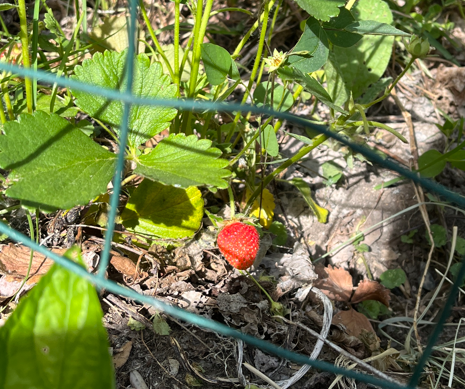
I’m rolling the dice by letting this one continue to ripen in the vine, but I have this dream of having one perfectly ripe and fragrant strawberry from my own damn garden. Not sure the critters will allow that, but I can dream?
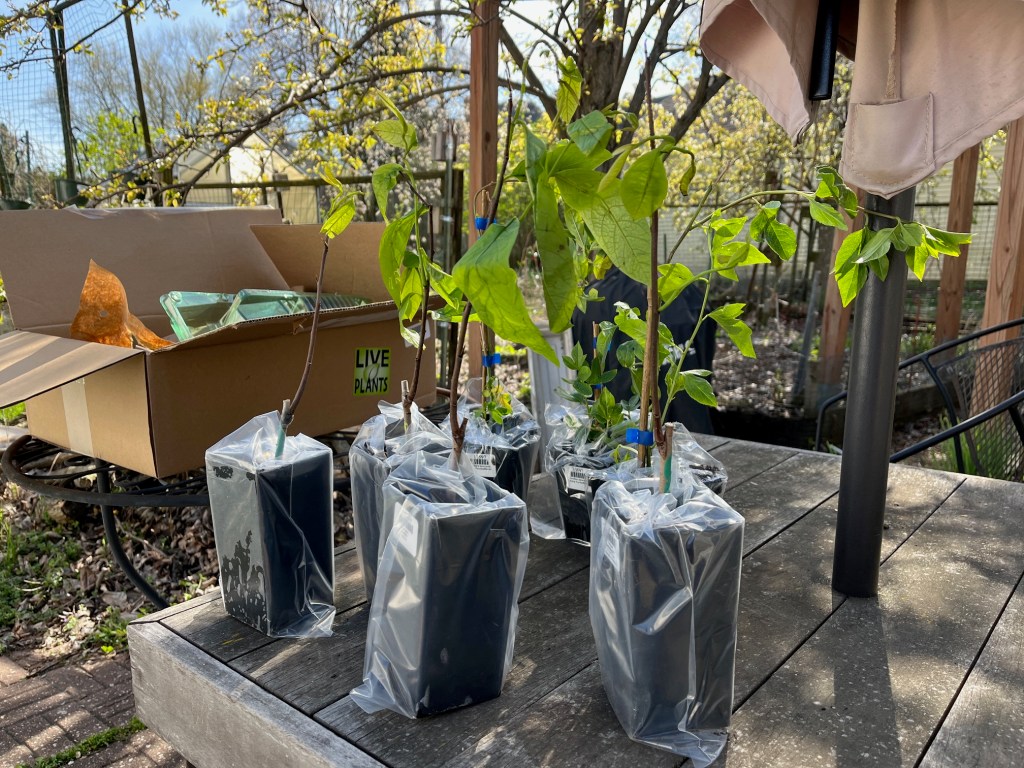
In other perennial news – the pawpaws I put in recently seem to be settling in quite well. I was quite worried – two of them were reduced essentially to sticks for a while, and the other two only had jagged, decrepit leaves remaining after shipping – but they are all slowly and steadily leafing out and seem at least somewhat happy where they are. Just gotta keep them going for 5-7 years now to get them to fruiting age, about the same wait as we’ve got for the little American hazelnuts. I look forward to enjoying them all in my 50’s.
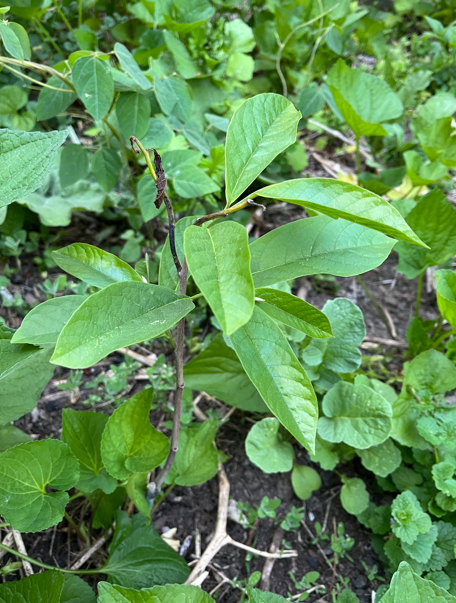
This pawpaw was a sad little twig when it arrived, but it’s been leafing out nicely!
Over the holiday weekend, my partner undertook the major project of turning the compost pile. The pile is about 6’x6’, around 3’ tall, so this is truly a *project*. Over the course of about three days he raked out the top layers, transferred the finished compost at the bottom over to the “ready to use” pile, and then mixed and raked everything remaining back into a nice pile. The fencing around the pile is on its last legs, so the tentative plan is to rip the structure out one of these years, and build a new one with several sections for material of various levels of degradation, in hopes that it makes the pile a little easier to manage.
(I have chosen not to include a picture of said compost; be assured that it is teeming with life and earthy smells.)
While my partner was pitchforking through the muck, I worked on transplanting tomato plants I started from seed, and bell peppers from a friend. Have also gotten a few of my skirret starts into the ground; I’m curious to see how well they do, considering that I think their ph preferences clash with the current batch of compost (being that it’s heavy on wood ash).
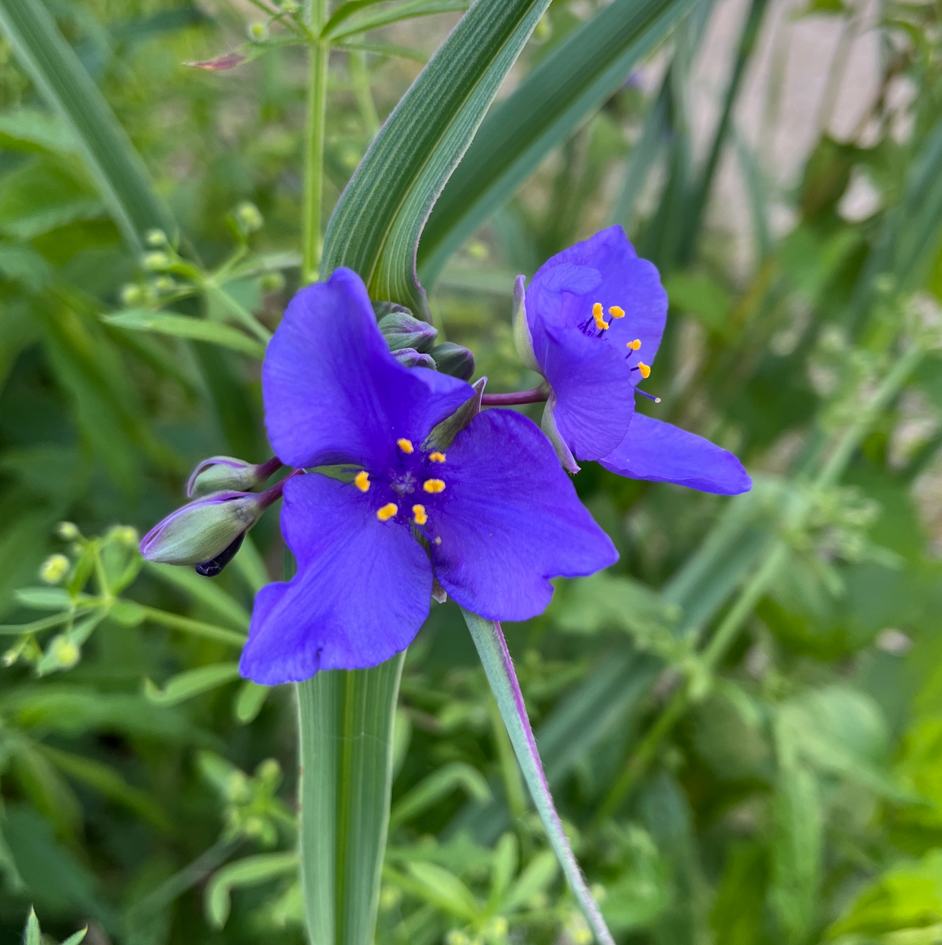
Here’s a cool spiderwort from the yard, before I get into the heavy thoughts.
I’ve been noticing that insect abundance is surprisingly low at the moment. It may not stay that way, and I’m not saying we should all panic or anything, this is just one local observation. It’s just been hard to ignore when it’s so obvious in my day to day. In past years, when the pears and plums were blooming, or the honeysuckle, or the salvia, they would be covered in bees of at least a dozen species. There were so many that the buzzing rose to a pleasant, constant hum, like a little pollinator kazoo chorus during the daytime. There are still bees, of many species, but their numbers are considerably lower, and I miss their little buzzy background noise.
It’s difficult to spend so much time in close contact with nature and not think about the polycrisis, because there are a hundred reminders, like the bees, and the pears I mentioned above. Sometimes that’s sad – a reminder of things that have been lost, and things that will be lost. It’s also interesting, though, and a reminder that the only constant in life is change. I commented to a friend recently, in a conversation about current happenings in politics, trade, and war, that it was in many ways a deeply frightening time to be alive – but that it’s also an incredibly interesting one. I probably engage with more of the scary information than I need to, because understanding it, parsing it, gauging reliability, and stitching together greater understanding from the pieces, is just so bloody fascinating.
But, I know who I am, and my tendency towards anxiety, so I can’t always engage with that knowledge. Sometimes I need to go plant a seed, pull an invasive, or water a plant, and just remind myself that there are things that I can, if not control, at least influence. And so again, I find myself back in the garden, because it’s therapy.
Spring hath sprung, and continues to spring along at rates I cannot hope to keep pace with, but that’s part of the fun, and I try anyway.
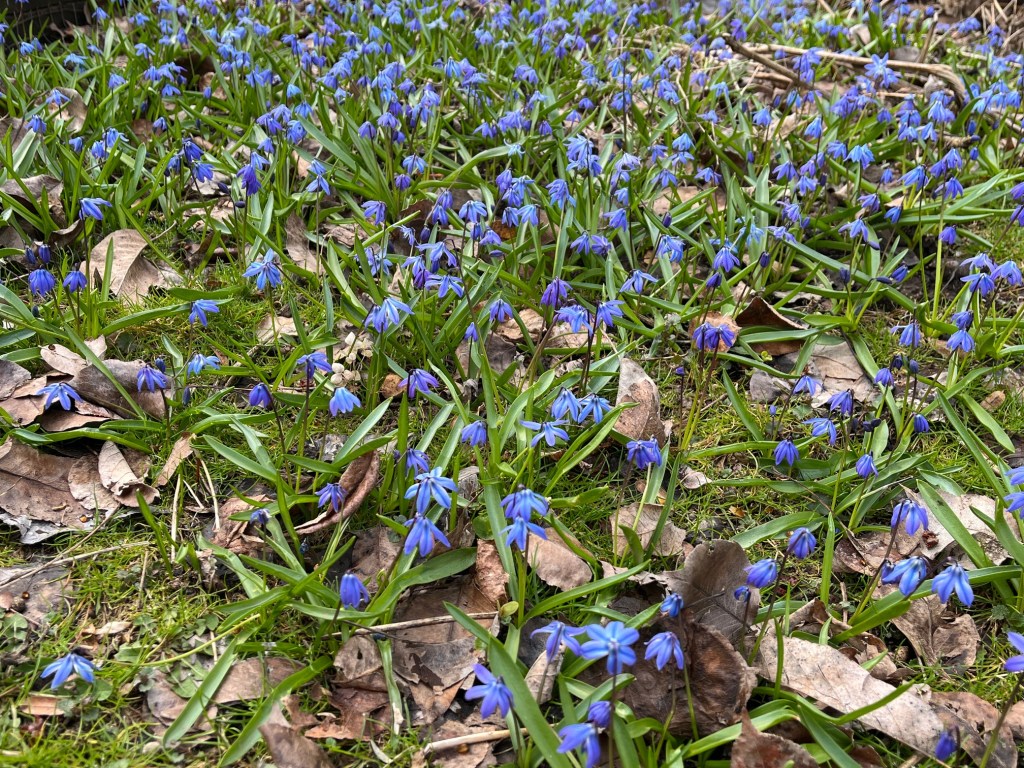
The first flower up and blooming in the yard was, as per usual, Siberian Squill (Scilla siberica). She is beautiful, but she is also fecund, inedible to native wildlife, and persistent. She is my garden nemesis.
Pretty, but seriously, fuck this plant.
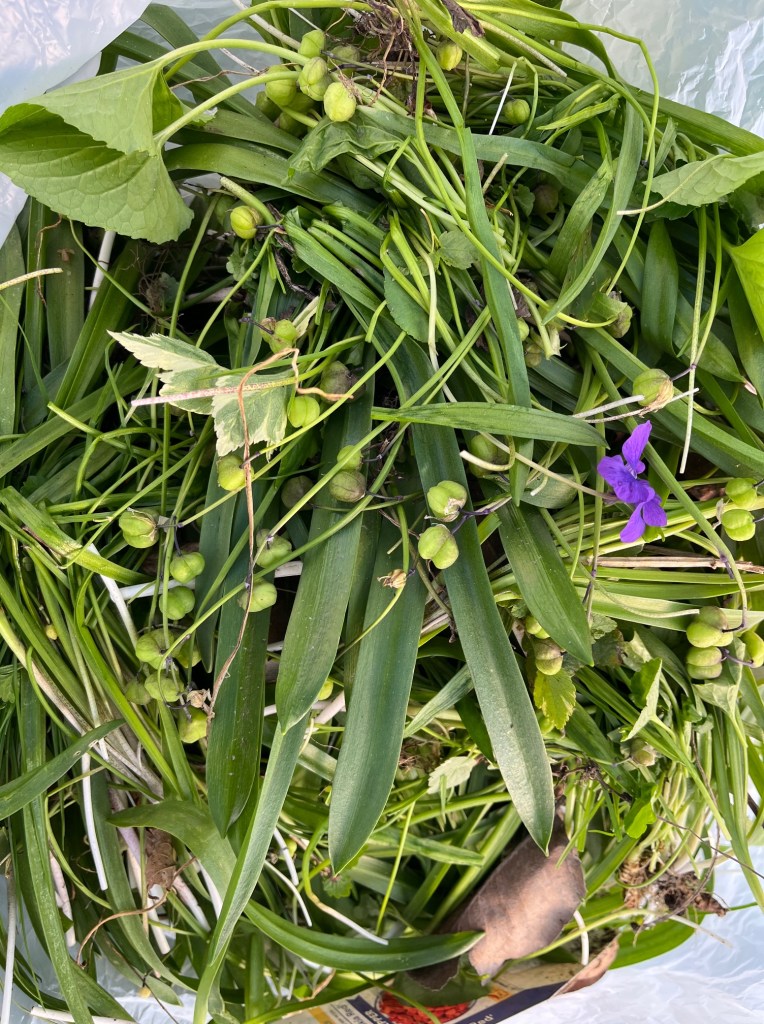
This year, starting in late March, I have pulled up three full plastic grocery bags worth of squill, doing my best to get the bulbs. I barely made a dent in them. They’ve likely been here decades longer than me, so it’s going to be a years-long uphill battle, but they’re simply too invasive and aggressive for me to tolerate them in the numbers they’re in. I am researching early blooming native alternatives, because squill at least does the courtesy of having very early and cold-tolerant blooms, which help provide for insect pollinators as they wake up, but it’ll be a long time before I make enough of a dent in them to necessitate functional replacements.
At this stage in the season I’ve abandoned the notion of trying to pull bulbs, and am instead focusing on just pulling up the plant (so it can’t keep feeding the bulb) and getting the seed pods (because each of those puppies have like a hundred seeds in them, and the germination rates are insane). Don’t worry about the violet caught in the friendly fire, we’ve got a bazillion of them.
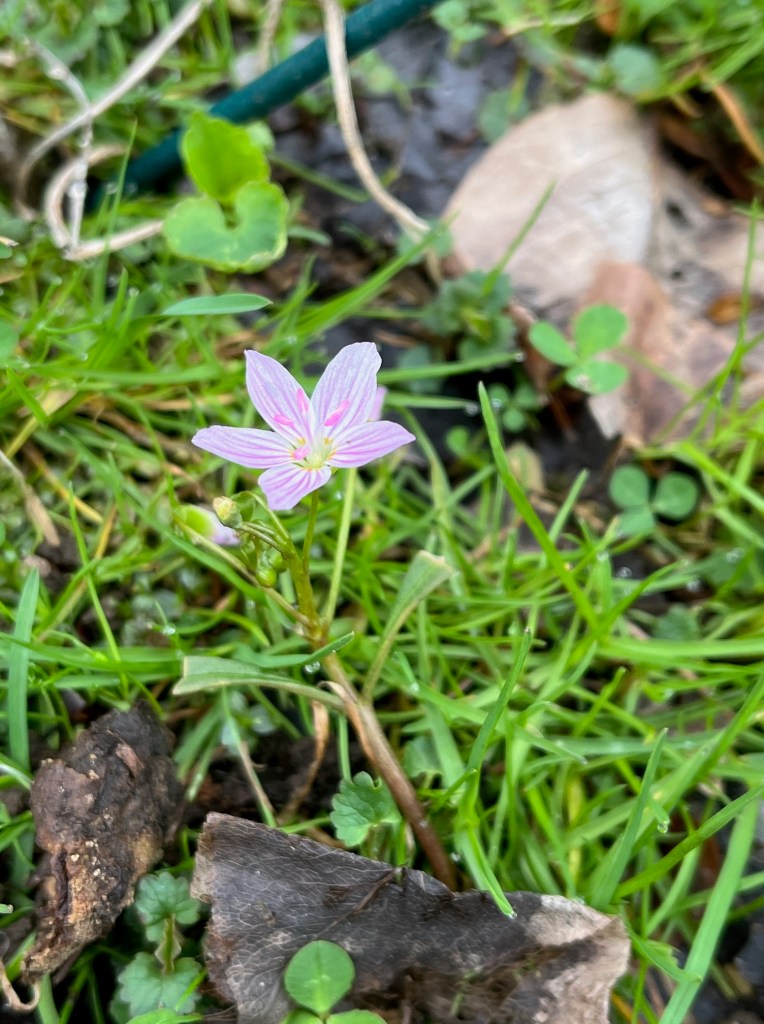
Counterbalancing the unexpected and unwelcome squill, is the unexpected and very welcome Spring Beauty (Claytonia virginiana). I picked up some seeds for this woodland spring ephemeral about four years ago, and spread them in an area under our pear trees. They then did not make any appearances until confusingly, last year, one of them popped up in the far side of the yard, and then this year, two popped up closer to the pear trees, but in the middle of a grassy area. I know the seeds for spring beauty are distributed by ants, so….maybe they are showing up where they have because ant reasons? Regardless, I’m delighted they decided to join the party, and have marked their location so they don’t get mowed (er, again) until they’re done blooming.
Spring beauty lives up to its name, despite having been mowed over early in the season, before we realized it was there.
Speaking of early risers, it looks like all of the strawberry plants I put in last year – all 18 or so, literally rescued from a dumpster – seem to have survived. I’m hoping that by letting them run wild all around the garden, there will eventually be enough strawberries produced that the strawberry-eating wildlife misses a few, so that I can actually eat one. I’m not optimistic about this, but worst case scenario, at least someone gets fed, and they’re low maintenance.
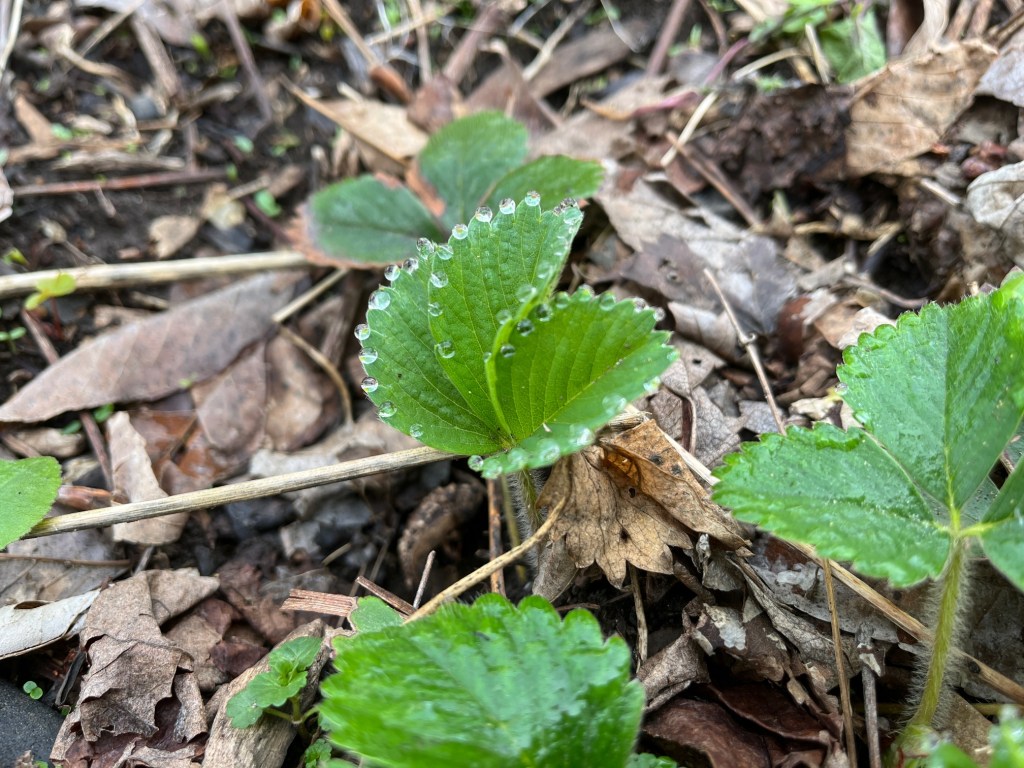
The droplets on these strawberry leaves are the result of guttation; in wet conditions, water can enter the roots due to relative solute levels and cause pressure to propagate through the xylem, resulting in liquid being pushed out at the leaf edges.
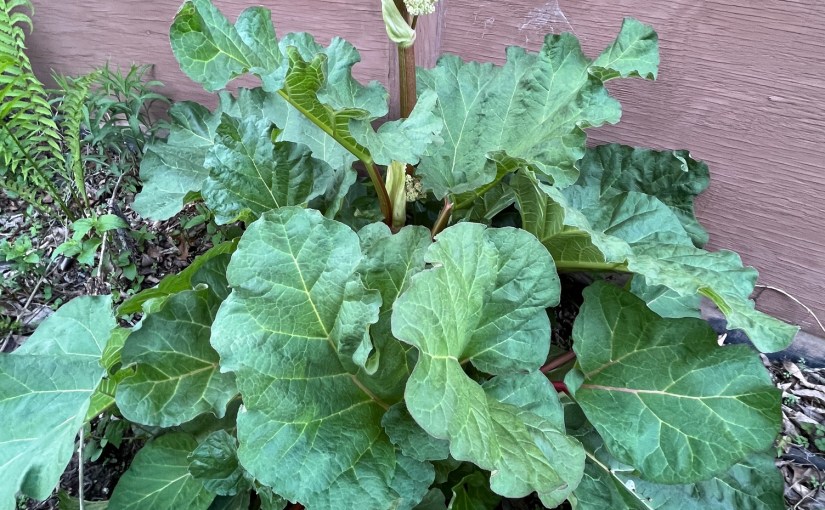
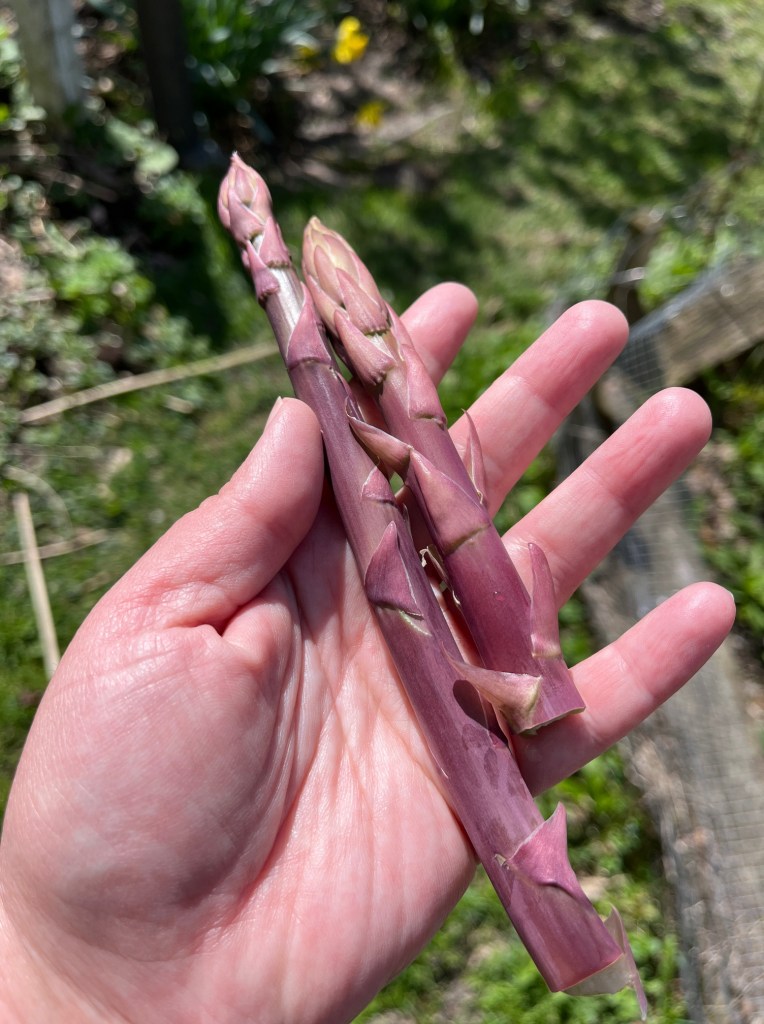
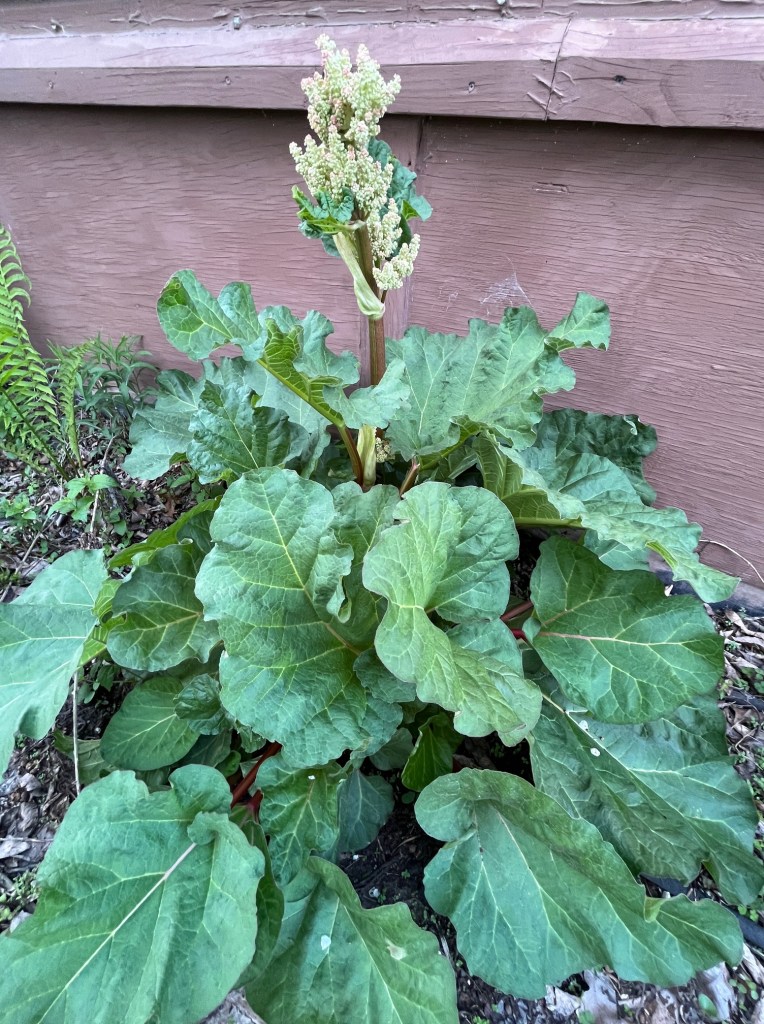
The asparagus yielded our first garden snack of the season; we planted the first crowns four years ago, but asparagus is slow to get established, and this is the first year they’ve been robust enough for me to be comfortable harvesting from them. I did find my first batch of asparagus beetles of the season today, so I’ll have to try to spend some quality time doin’ a bug murder. Also on the perennial edible vegetable front, the rhubarb has both leafed out, and decided to flower this year, for the first time since we moved in. I had not realized previously what a slow and dramatic diva the rhubarb flower is; it’s been unexpectedly interesting to watch it grow and unfurl.
Noms!Category is vernal goddess realness, slay queen!
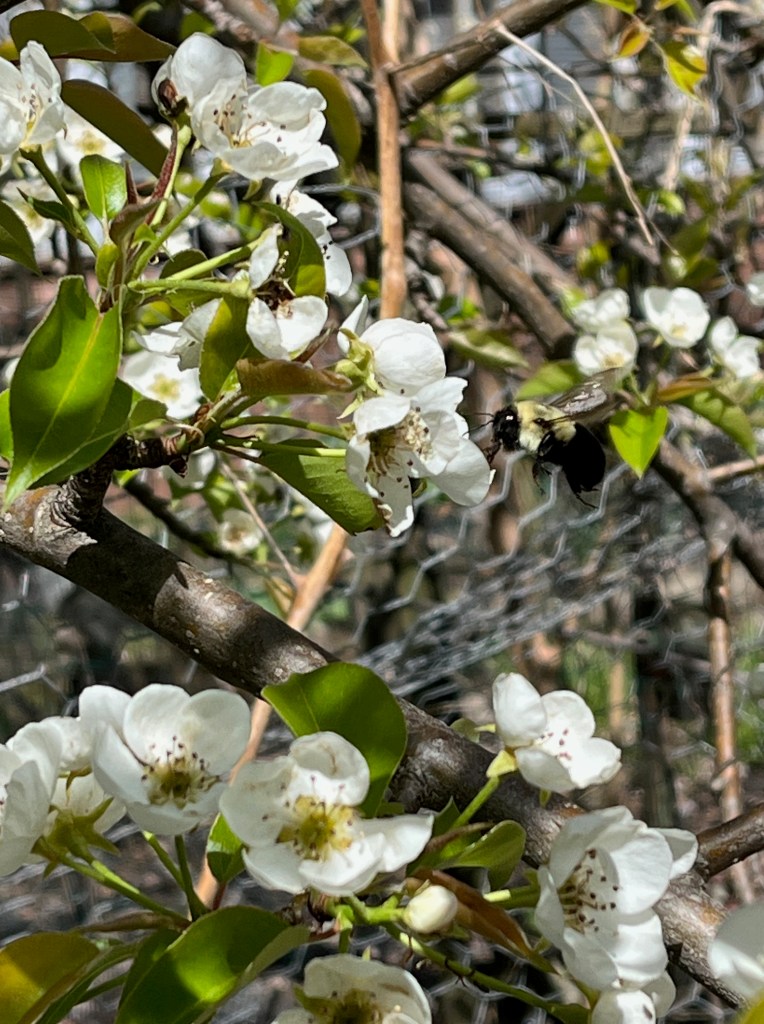
The plums flowered, followed shortly thereafter by the pears, the honeyberries, and the crabapple. The black and red raspberries have all leafed out and are doing well, although they’re nowhere near flowering yet.
The audible range of buzzing sounds around the pear tree, from a dozen or more different species of bees, is one of my favorite parts of early spring.
We also added to the mini-orchard; I purchased four pawpaw trees and three maypop vines, and was graciously gifted a number of year-old American hazelnut seedlings by a friend. After being transplanted to their new homes, the hazelnuts seem unbothered, but the pawpaws and maypops are struggling. I’ll reserve judgement until they’ve had more of a chance to settle in, though.
Stressed about my new pawpaw and passionflower babies, but I tend to be a harsh mistress in the garden; I try not to waste a ton of time and energy to make certain plants happy, because I assume if it’s not working, it’s just not a great fit. If these guys fail, I’ll be sad, but I’ll rip ’em out and replace them with serviceberries or something and move on.
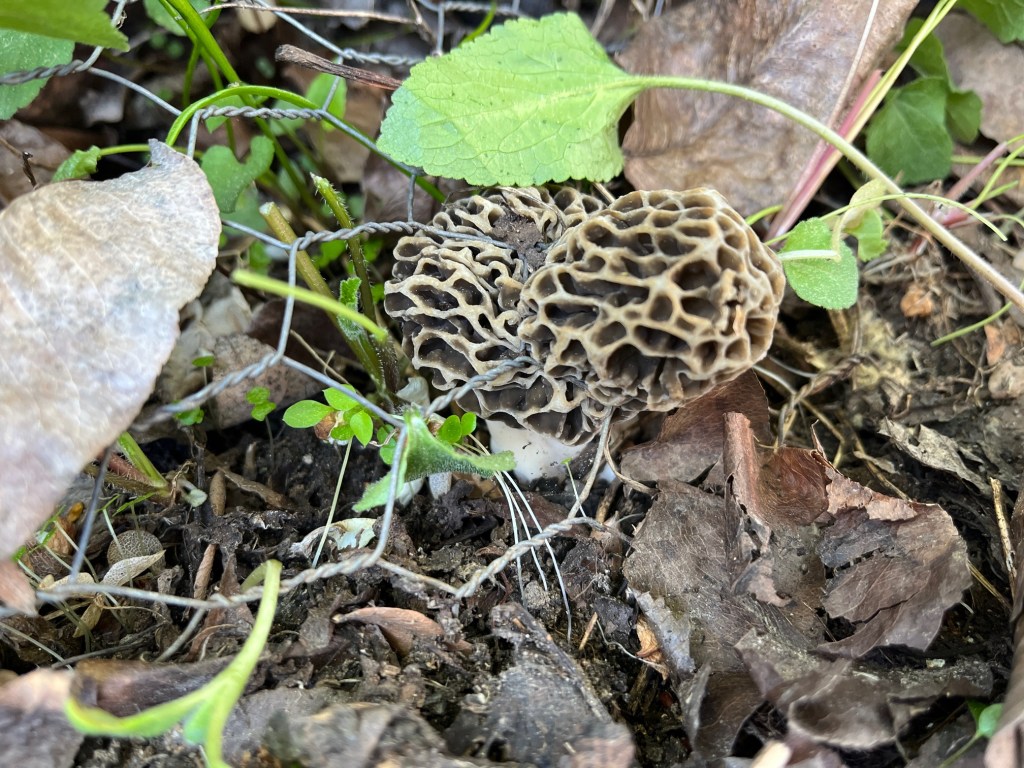
I’m pleased with the progress I’ve made in adding native woodland plants, both edible and non-edible (at least, for humans). Last year I was able to get some wild ginger from a coworker who was thinning their well-established colony; they apparently wintered quite well and have sprung back. The nodding onion patch is three years old now and continues to widen, and miraculously, the three ramps that popped up last year – after I spread seeds around two years prior – have returned, and are looking good. I was also able to get some bloodroot today from a friend whose neighbor was thinning their colony. As I was clearing some weedy plants from a spot under one of the pears to make room for the bloodroot, I uncovered quite a stately looking morel. I’ve found a couple half-free morels in the yard before – unfortunately not in time to catch them in an edible state – but I think this one is a white morel (Morchella esculenta), one of the more choice species for consumption. This one was also too old for eating, but not too old to be broken up and spread around the foot of the other fruit trees, in hopes of future fungal harvests.
Awkward location, lil buddy!
Next task on the docket is to pot up the tomatoes I’ve started indoors, and to start hardening them off for transplant. Very excited to have so many new plants to get to know this year, and to see our efforts over the last four years to establish natives plants and perennials paying off!