View of April, facing the garden

Spring hath sprung, and continues to spring along at rates I cannot hope to keep pace with, but that’s part of the fun, and I try anyway.

The first flower up and blooming in the yard was, as per usual, Siberian Squill (Scilla siberica).  She is beautiful, but she is also fecund, inedible to native wildlife, and persistent.  She is my garden nemesis.  
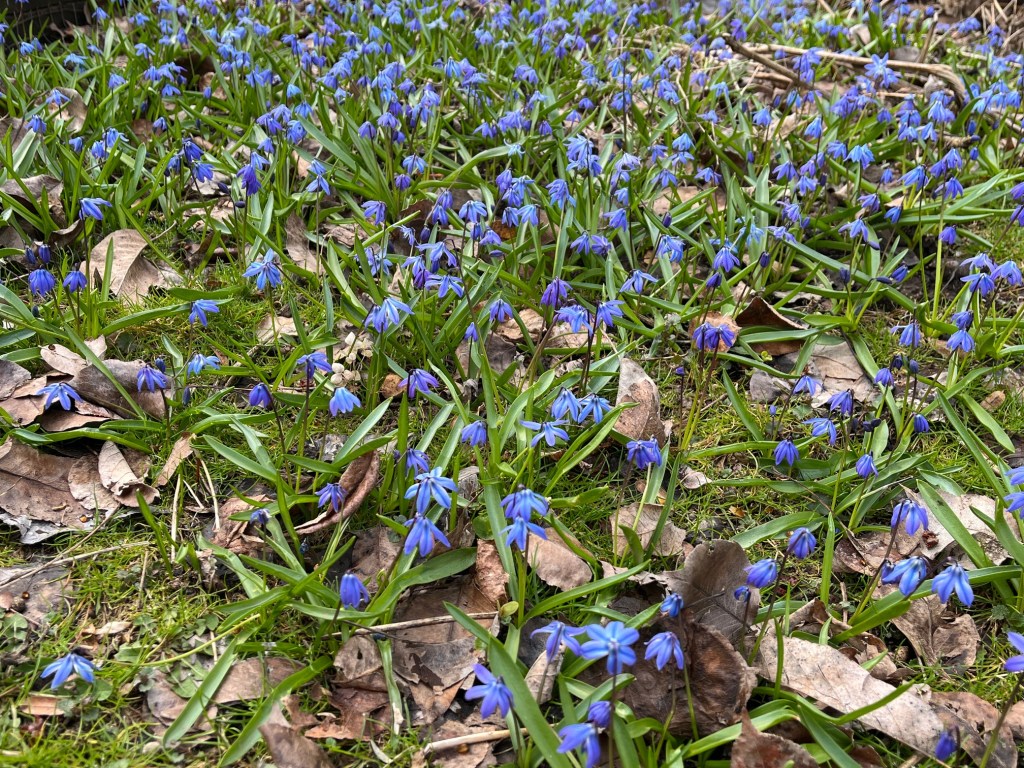
Pretty, but seriously, fuck this plant.

This year, starting in late March, I have pulled up three full plastic grocery bags worth of squill, doing my best to get the bulbs.  I barely made a dent in them.  They’ve likely been here decades longer than me, so it’s going to be a years-long uphill battle, but they’re simply too invasive and aggressive for me to tolerate them in the numbers they’re in.  I am researching early blooming native alternatives, because squill at least does the courtesy of having very early and cold-tolerant blooms, which help provide for insect pollinators as they wake up, but it’ll be a long time before I make enough of a dent in them to necessitate functional replacements.
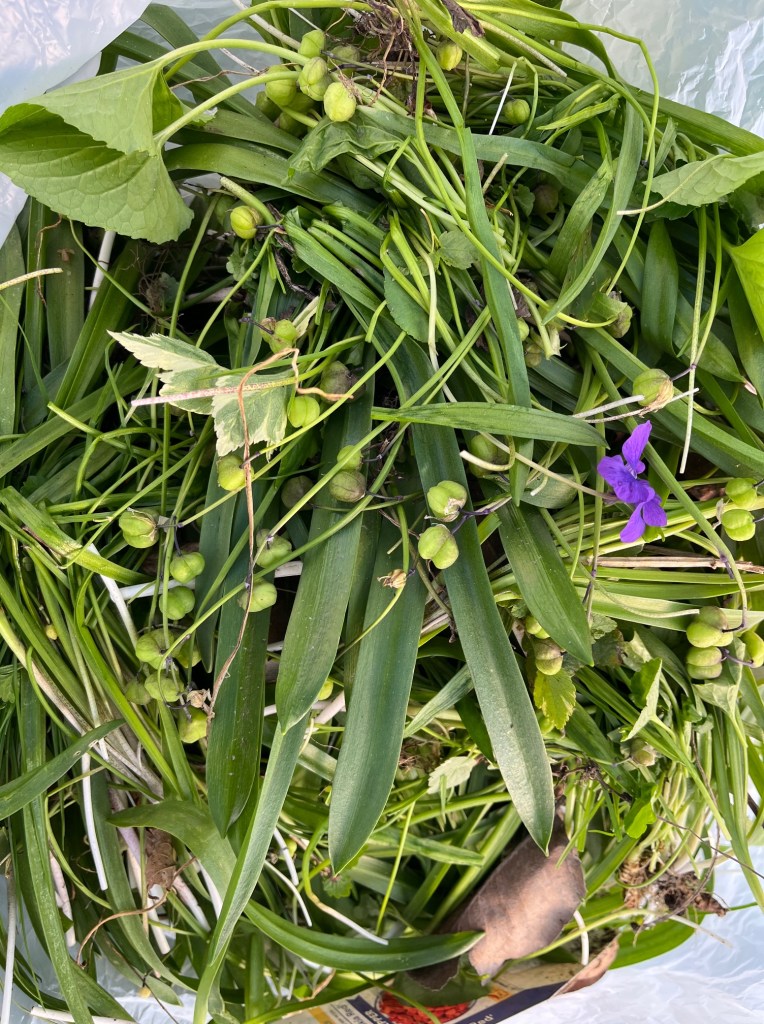
At this stage in the season I’ve abandoned the notion of trying to pull bulbs, and am instead focusing on just pulling up the plant (so it can’t keep feeding the bulb) and getting the seed pods (because each of those puppies have like a hundred seeds in them, and the germination rates are insane). Don’t worry about the violet caught in the friendly fire, we’ve got a bazillion of them.

Counterbalancing the unexpected and unwelcome squill, is the unexpected and very welcome Spring Beauty (Claytonia virginiana).  I picked up some seeds for this woodland spring ephemeral about four years ago, and spread them in an area under our pear trees.  They then did not make any appearances until confusingly, last year, one of them popped up in the far side of the yard, and then this year, two popped up closer to the pear trees, but in the middle of a grassy area.  I know the seeds for spring beauty are distributed by ants, so….maybe they are showing up where they have because ant reasons?  Regardless, I’m delighted they decided to join the party, and have marked their location so they don’t get mowed (er, again) until they’re done blooming.  
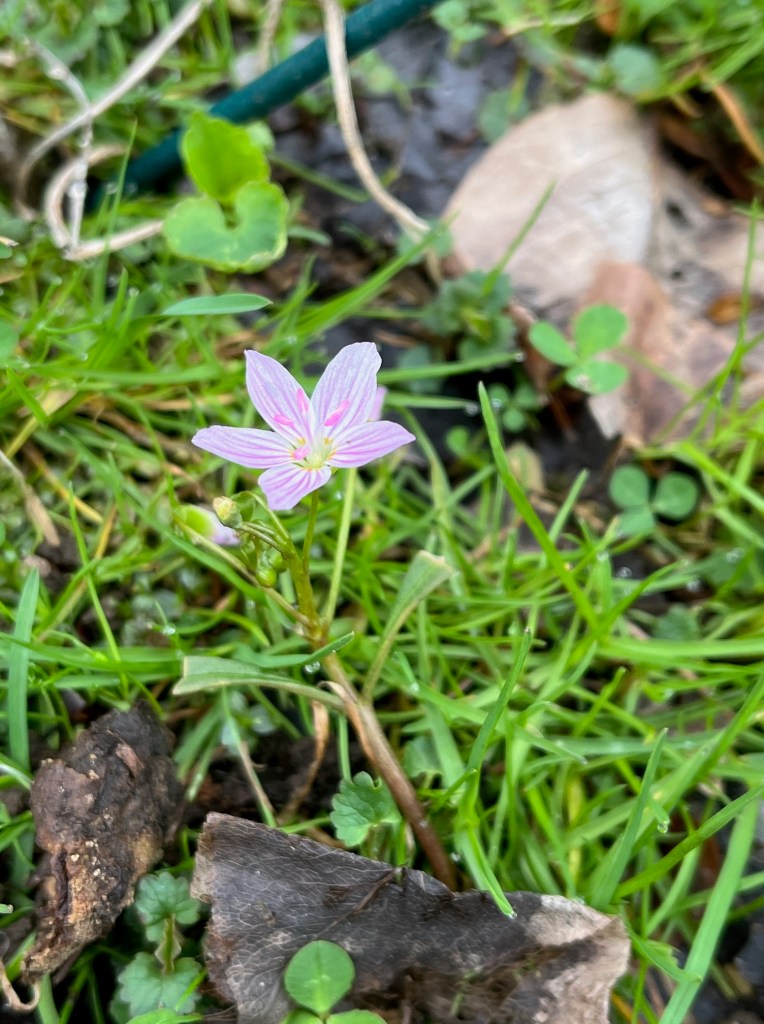
Spring beauty lives up to its name, despite having been mowed over early in the season, before we realized it was there.

Speaking of early risers, it looks like all of the strawberry plants I put in last year – all 18 or so, literally rescued from a dumpster – seem to have survived.  I’m hoping that by letting them run wild all around the garden, there will eventually be enough strawberries produced that the strawberry-eating wildlife misses a few, so that I can actually eat one.   I’m not optimistic about this, but worst case scenario, at least someone gets fed, and they’re low maintenance.
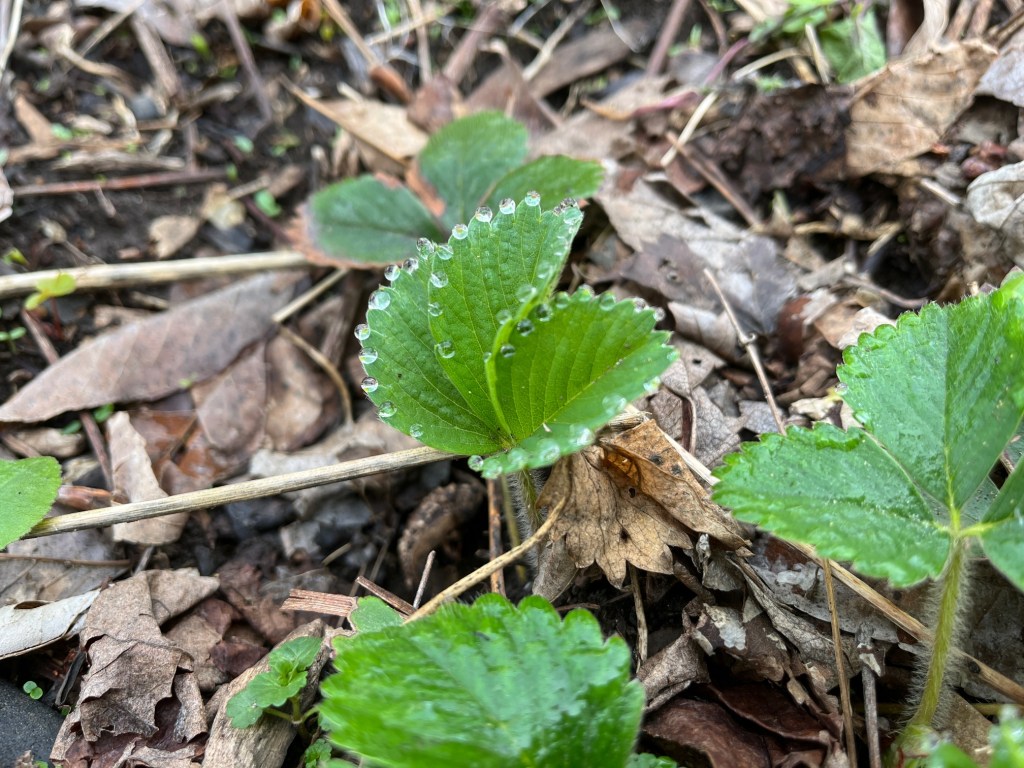
The droplets on these strawberry leaves are the result of guttation; in wet conditions, water can enter the roots due to relative solute levels and cause pressure to propagate through the xylem, resulting in liquid being pushed out at the leaf edges.

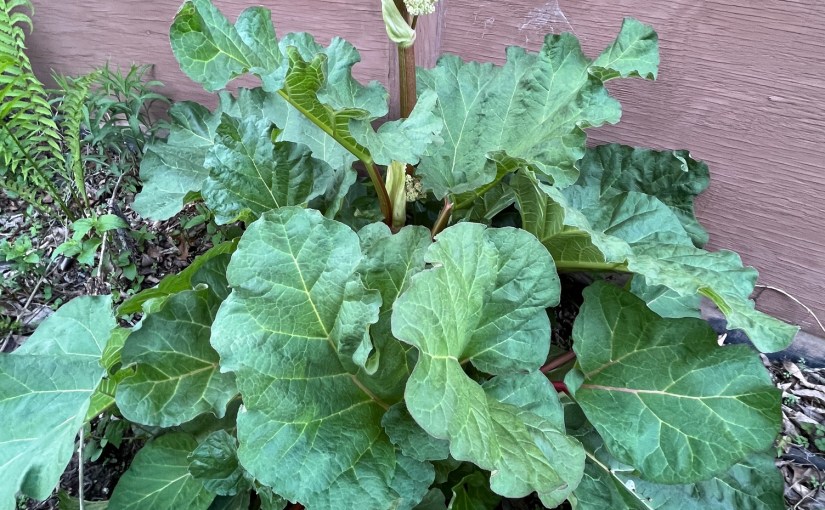
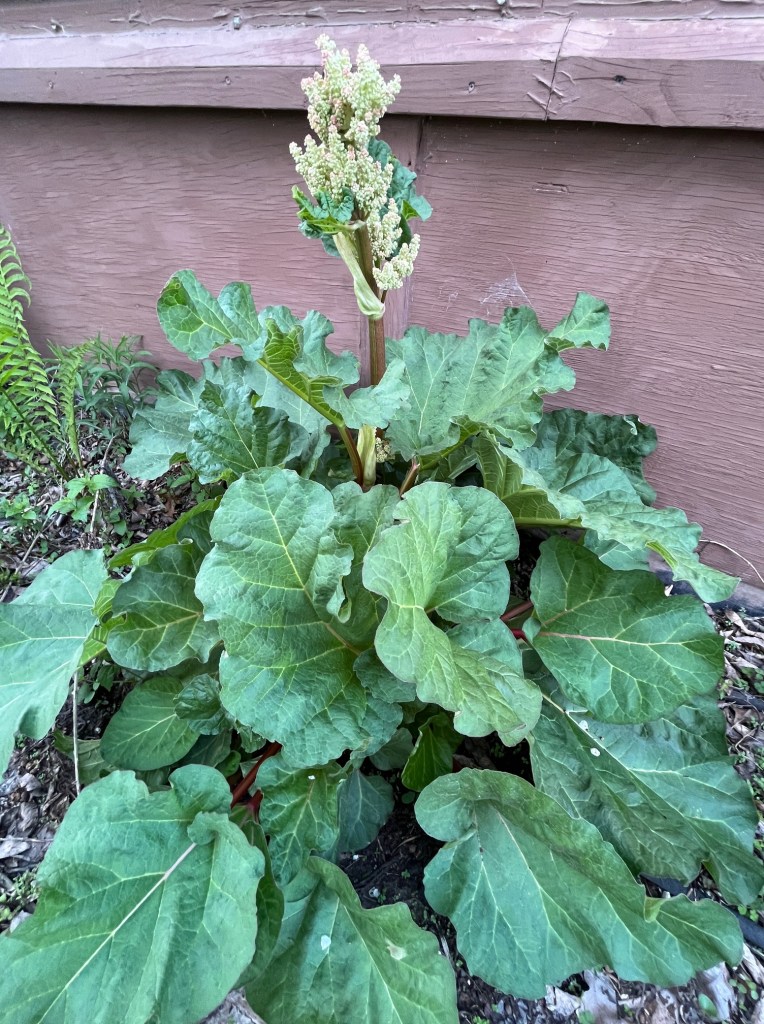
The asparagus yielded our first garden snack of the season; we planted the first crowns four years ago, but asparagus is slow to get established, and this is the first year they’ve been robust enough for me to be comfortable harvesting from them. I did find my first batch of asparagus beetles of the season today, so I’ll have to try to spend some quality time doin’ a bug murder.  Also on the perennial edible vegetable front, the rhubarb has both leafed out, and decided to flower this year, for the first time since we moved in.  I had not realized previously what a slow and dramatic diva the rhubarb flower is; it’s been unexpectedly interesting to watch it grow and unfurl.
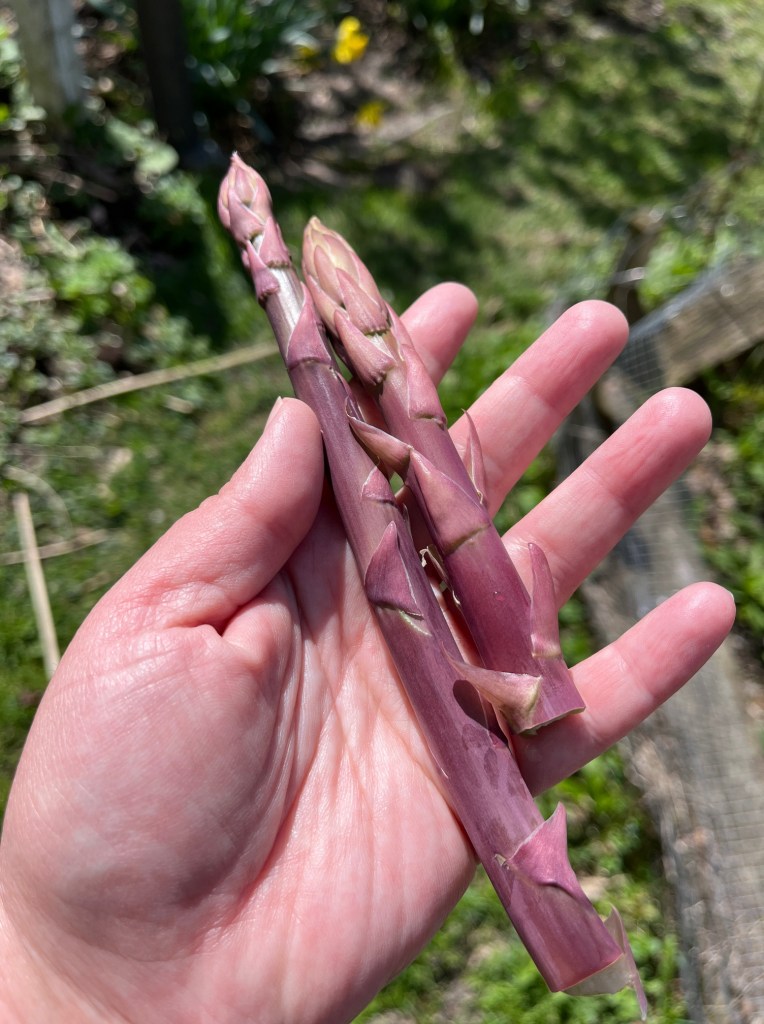
Noms!
Category is vernal goddess realness, slay queen!

The plums flowered, followed shortly thereafter by the pears, the honeyberries, and the crabapple.  The black and red raspberries have all leafed out and are doing well, although they’re nowhere near flowering yet. 
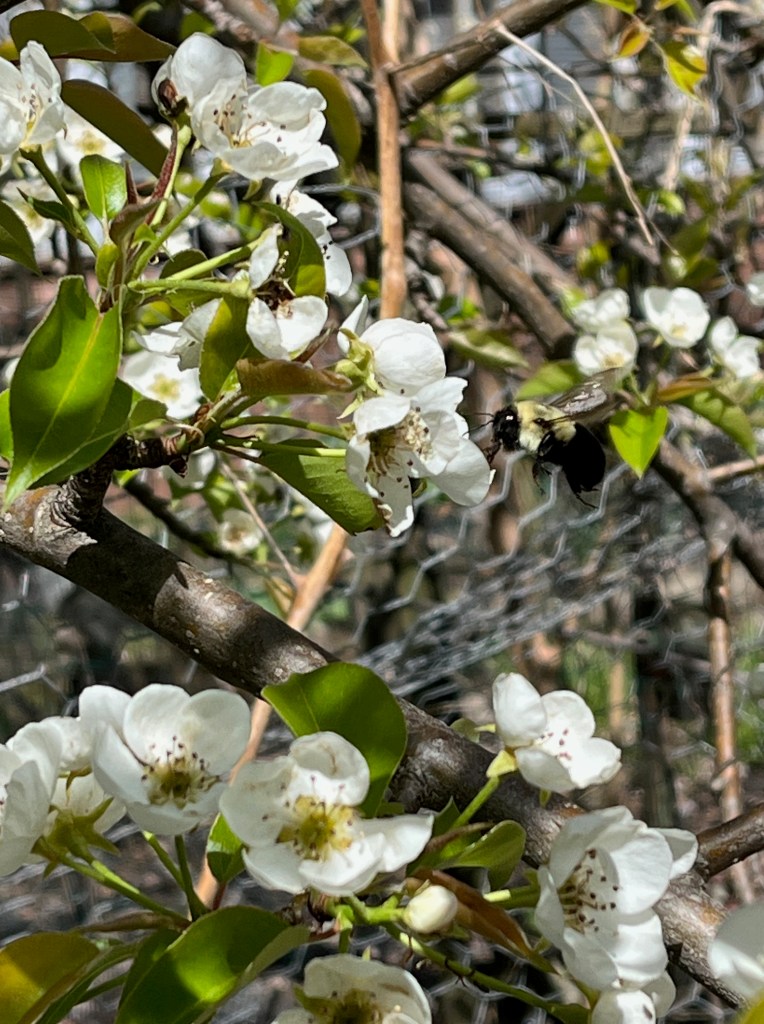
The audible range of buzzing sounds around the pear tree, from a dozen or more different species of bees, is one of my favorite parts of early spring.

We also added to the mini-orchard; I purchased four pawpaw trees and three maypop vines, and was graciously gifted a number of year-old American hazelnut seedlings by a friend.  After being transplanted to their new homes, the hazelnuts seem unbothered, but the pawpaws and maypops are struggling.  I’ll reserve judgement until they’ve had more of a chance to settle in, though.  
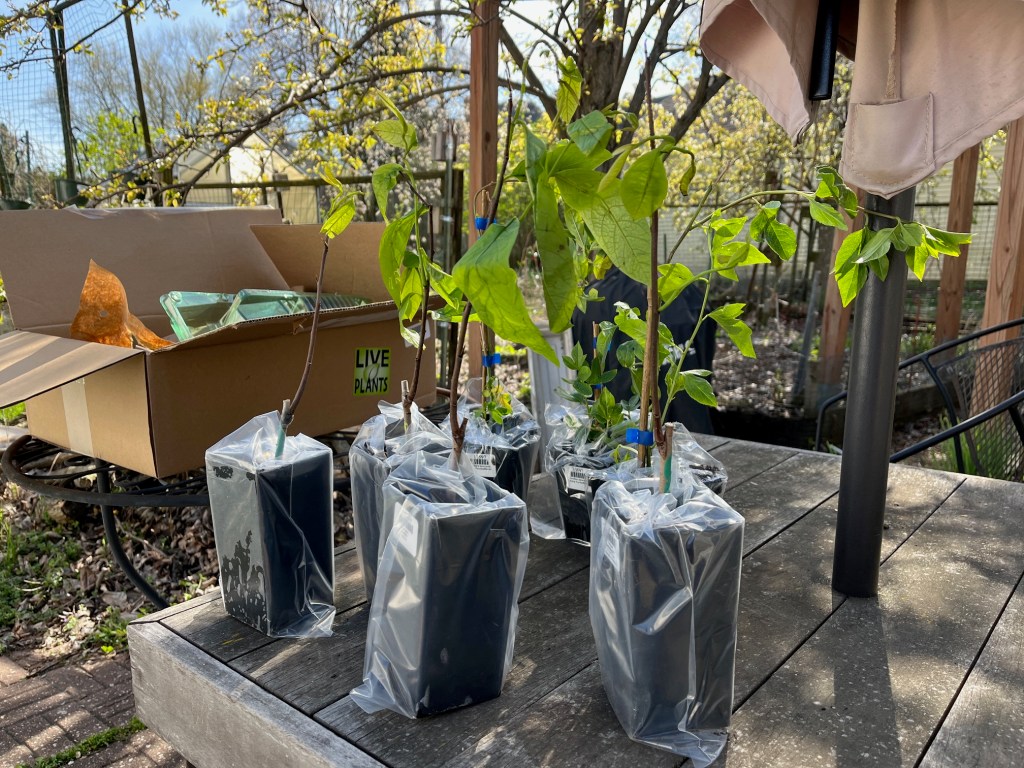
Stressed about my new pawpaw and passionflower babies, but I tend to be a harsh mistress in the garden; I try not to waste a ton of time and energy to make certain plants happy, because I assume if it’s not working, it’s just not a great fit. If these guys fail, I’ll be sad, but I’ll rip ’em out and replace them with serviceberries or something and move on.

I’m pleased with the progress I’ve made in adding native woodland plants, both edible and non-edible (at least, for humans).  Last year I was able to get some wild ginger from a coworker who was thinning their well-established colony; they apparently wintered quite well and have sprung back.  The nodding onion patch is three years old now and continues to widen, and miraculously, the three ramps that popped up last year – after I spread seeds around two years prior – have returned, and are looking good.  I was also able to get some bloodroot today from a friend whose neighbor was thinning their colony.  As I was clearing some weedy plants from a spot under one of the pears to make room for the bloodroot, I uncovered quite a stately looking morel.  I’ve found a couple half-free morels in the yard before – unfortunately not in time to catch them in an edible state – but I think this one is a white morel (Morchella esculenta), one of the more choice species for consumption.  This one was also too old for eating, but not too old to be broken up and spread around the foot of the other fruit trees, in hopes of future fungal harvests.  
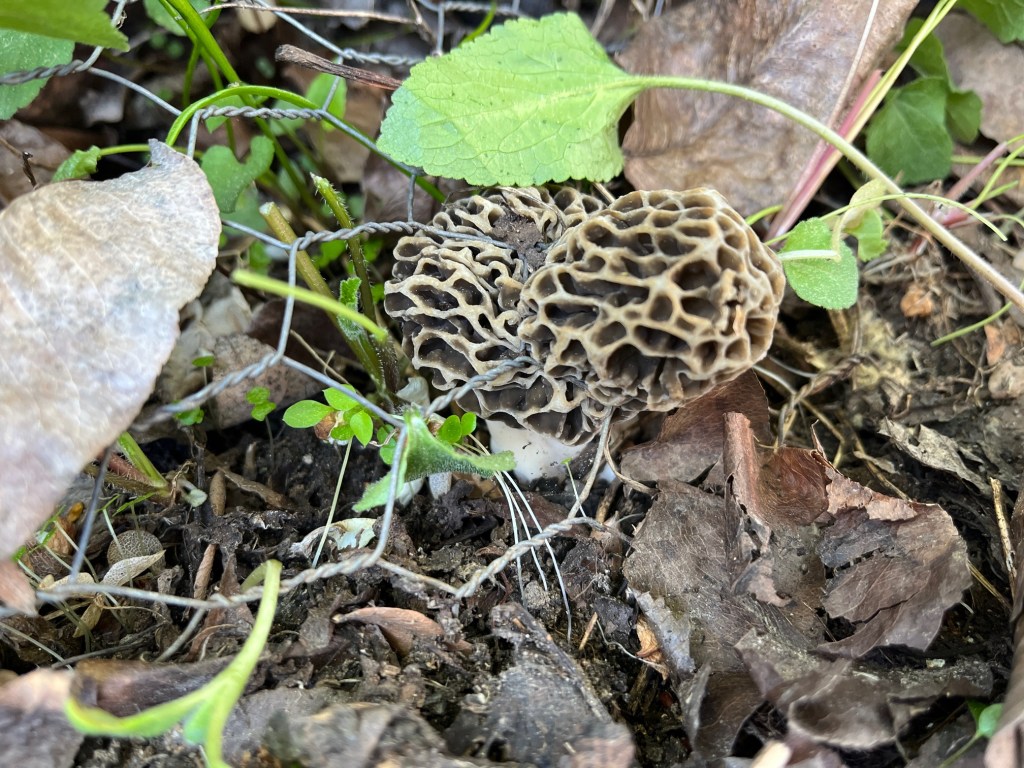
Awkward location, lil buddy!

Next task on the docket is to pot up the tomatoes I’ve started indoors, and to start hardening them off for transplant. Very excited to have so many new plants to get to know this year, and to see our efforts over the last four years to establish natives plants and perennials paying off!
Sugaring, and Springing Forth in Earnest

I’m not quite sure how to do this, but, I want to acknowledge that there’s kind of a lot of terrifying shit going on. I recognize and acknowledge that even in such times, we all need to chop wood/carry water, and that there’s obviously nothing wrong in taking comfort in the domestic and the comfortable. It just feels extremely weird to be assembling a post on my anodyne, cottagecore hobbies at such a time, especially when I have about a dozen half-written posts burning a hole in my Google Drive relating to various aspects of the Big Stuff happening right now. Those thoughts deserve to be polished before I put them out Here, though, and at the same time I want to stick to my goal of posting at least once a month. And maybe hearing about my anodyne, cottagecore hobbies will be in any way comforting to someone. Anyway, here goes.

Maple sugaring went quite well! The weather, despite some turbulence (surprise, here’s a foot of snow overnight, in the middle of March, rapidly followed by 70 degree temps!) stayed cool enough to give us a nice long sugaring season before bud break – which I believe still hasn’t happened quite yet, but should any day. (Bud break is when dormant buds begin to wake up and you can see bits of green start of appear; when this happens – or maybe because of it? I am not sure on the flow of causation here – the tree alters the chemical composition of the sap to better meet the needs of growing, young leaves. The changes mean that the sap turns bitter and unpalatable, known by the strangely cute term “buddy sap”.) About a week ago I noticed when I sampled the latest batch of sap that it was noticeably less sweet than it had been earlier in the season, and the flow rate slowed down dramatically over the last few days, so we decided to call it for the year and pulled out the taps.

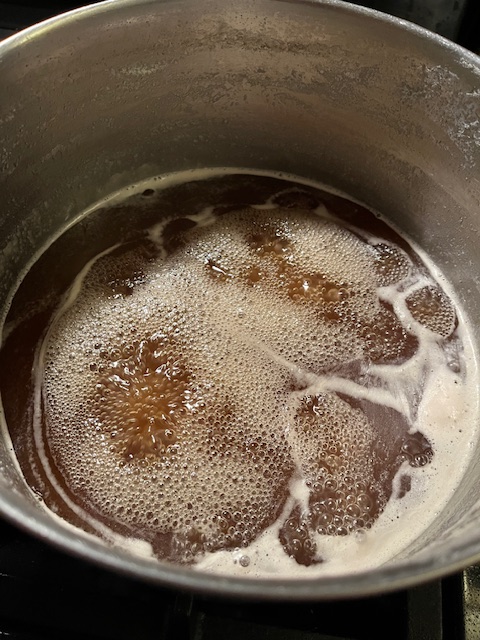
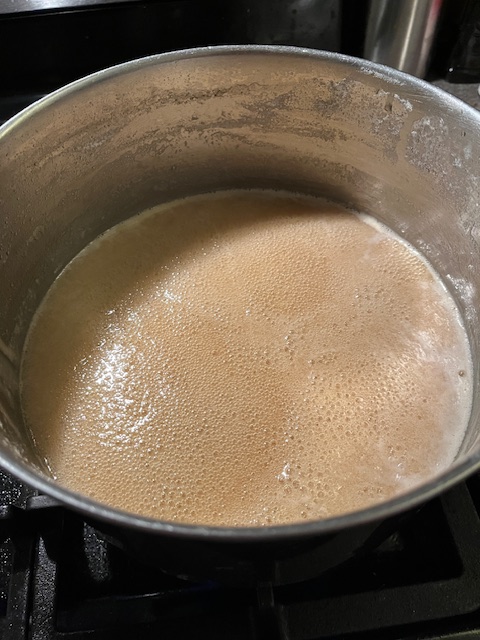
We finished off our very first batch of syrup almost a month ago now, quite on accident. When finishing off syrup – which just means the last stretch of boiling before hitting the right concentration of syrup – there’s a point just as you achieve syrup consistency where it suddenly starts foaming up very quickly, and if you are not paying quite close attention, can quite easily overflow even a relatively large container.

Mistakes were made, we weren’t paying enough attention and we lost maybe a quarter pint (it’s hard to gauge volume when it’s in a spreading pool on your stovetop). I was quite upset for about ten minutes, but I got over it, and we have chalked this up to being an Important Lesson and an Offering to the Kitchen Gods. We didn’t have any further unfortunate incidents, so clearly the sacrifice worked.

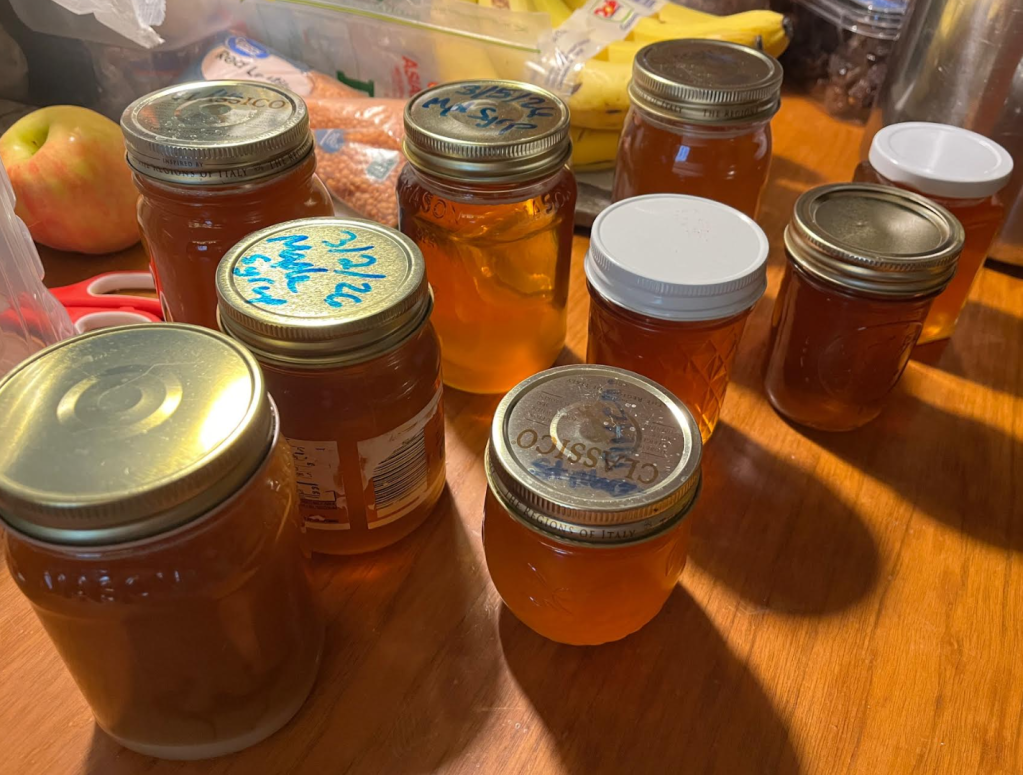
Minor setbacks aside, we ended the sugaring season with about nine pints in jars. We could have done water bath canning and made it all shelf-stable, but….meh, we have refrigerator space. If we get really motivated we could still reboil it and can it.

There were a couple more jars, but they’ve already been distributed to family.

You’ll note in the photo above that there’s a white sediment collecting at the bottom of the jars. This is what’s called niter, or maple sand. Rather infuriatingly, I’ve seen some homesteader influencer type videos where the creator confidently declared that this substance is crystalized sugar, which is absolute bullshit. Sap has plenty of other stuff in it besides sugar, even before bud break; the white precipitate is largely made up of calcium and magnesium. It’s edible and harmless, just not super aesthetically pleasing, so it’s filtered out of commercially produced and packaged syrup. It doesn’t bother us, though, and we are working with such small quantities that I think we’d lose a meaningful amount of our syrup if we filtered it, just due to amount retained/lost in the filter itself. I actually kind of weirdly like it; it has no flavor, and when you get down to the bottom of the jar, you just end up with sort of a very slightly grainy paste consistency that spreads very nicely on a toasted bagel.

We did learn a couple things during this sugaring season – mostly about what sorts of things work to weigh down the sap collection container in 70mpg wind gusts – but overall the process is….strangely doable? Weirdly manageable? It’s time consuming and there are certainly ways you can run into trouble – like my parents’ neighbors, who apparently boiled so much sap in their kitchen so quickly that the moisture did serious damage to their kitchen and they had to get all the drywall replaced – but those issues are avoidable with some common sense. I highly recommend it to anyone who has a bit of time, an appropriate tree, and any degree of sweet tooth. There is nothing quite as tasty as french toast served with your own homemade syrup.

Sugaring season’s end dovetailed nicely with our window for early spring garden prep. This week I’ve gotten some last minute pear tree trimming in and worked on cleaning out dead plants from some of the garden beds; tonight I set up my first tray of seedlings. Need to start another tray or two worth of seeds, see about getting some hazelnut shrubs ordered, and decide what my strategy is going to be for attacking the invasive Scilla this year.

As never-ending and frustrating as gardening can be, it’s comforting and distracting to have such a wide menu of tasks open to me. Things will slip, some things may just get away from me entirely (this is at least the third year I have wanted to get hazelnuts in), but that’s okay – there will always be more to do than I can handle, and still, somehow, the things I do get done will be enough to matter.

That’s probably a good lesson for me to carry with me out of the garden and into the rest of my life, particularly right now. I shall endeavor to do so.