This winter has sucked, for a variety of reasons – see previous blog post, for a big one – but even at the best of times, I struggle with this time of year. The dark doesn’t retreat quickly enough; the cold and snow start giving way just to transition into cold, wet and muddy, all the usual stuff people struggle with. On top of that, one of my greatest mental health (and probably physical health) stabilizers is just….contact with nature. Doing my druidy foraging/gardening thing. Touching plants, smelling the soil, caring for beings that in return care for me. It’s not that there’s none of that during winter, but it’s very limited. Having houseplants or a little hydroponic garden or something like that might help a little bit, but the cats just really, really like chewing on leaves, and I’m disinclined to burn effort struggling against their nature.
All this to say, it’s maple sugaring season, and I’m psyched.
We have one norway maple (Acer platanoides) in our yard. It’s an invasive species in North America, but they were (and in many places, still are) abundantly used in landscaping because they’re resilient, salt-tolerant, and have nice, dense, shady canopies. Ours is one of the last large shade trees along our street, and the trunk is nearly three feet in diameter: it’s a chonky boi, in the parlance of our times. The chonkiness and location are why I haven’t had it ripped out; it’s technically an invasive species, yes, but this individual is likely not really hurting much in its urban location. It’s also much larger than the village generally likes to see in a terrace, so its existence is sort of grandfathered in – I’m not sure it’d be explicitly against an ordinance to plug a burr oak or linden or something in as a replacement, but it’d probably piss someone off, and I’m not trying to antagonize anyone. It’d probably be a bad idea as far as the integrity of our underground utilities, too; norway maple root networks stay pretty shallow, which I suspect is why it hasn’t caused any issues for us (yet).
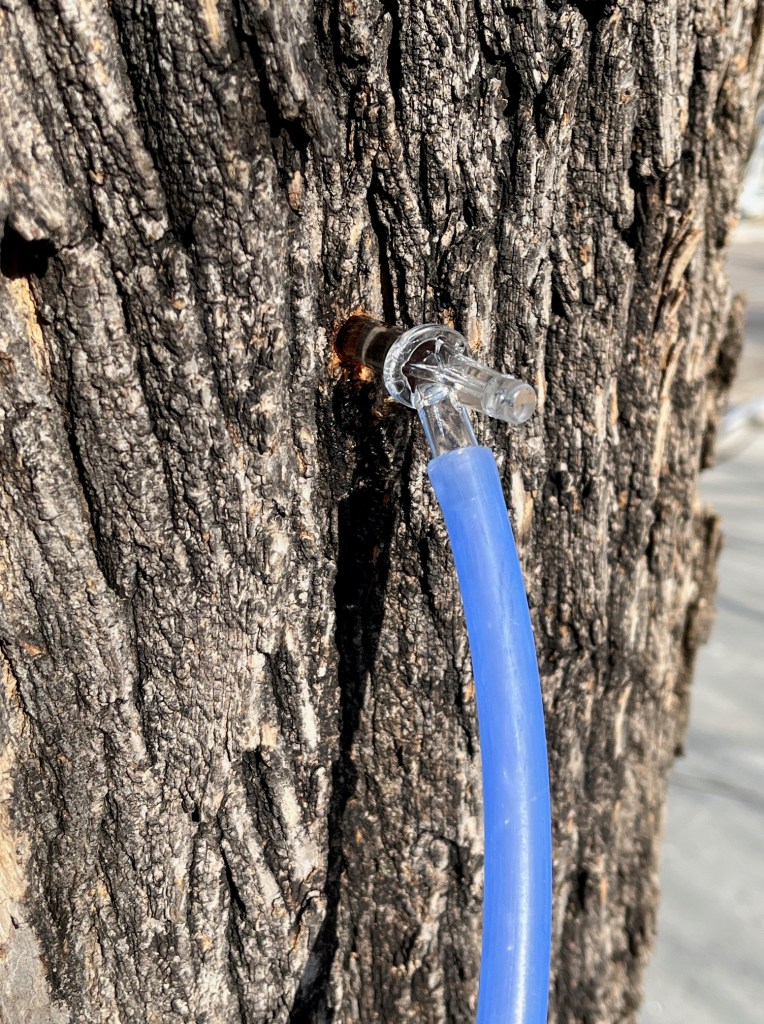
Norway maple isn’t considered a desirable species for maple sugaring – shockingly, sugar maples are better for it, what are the chances? – but you can tap pretty much any maple with a trunk at least a foot in diameter. (Some of the resources I’ve seen specify you can safely use any native maple tree of that size, which seems like CYA phrasing to me, but I guess it’s possible that there’s some obscure maple out there that wouldn’t work.) There’s a handful of other trees that you can tap for syrup as well – birch, black walnut, and basswood being some of the more common ones in my region – although it’s worth noting that some of them have much smaller concentrations of sugars in their sap than maples do, which means more sap and work is required for less finished product.
Despite our tree not being of a sought-after variety for tapping, the syrup we’ve made from it….is kind of fantastic? It’s a light amber color, very clear, and has an excellent (if perhaps a little mild) maple syrup flavor. And considering that we only have one tree, the amount is surprising, at least to me; we easily generated enough for the two of us to keep our french toast drenched for the course of a year and to share a bit with family. Of course, your mileage may vary, depending on how much french toast you eat. I’m hoping to wind up with something like a gallon of finished syrup at the end of the season.
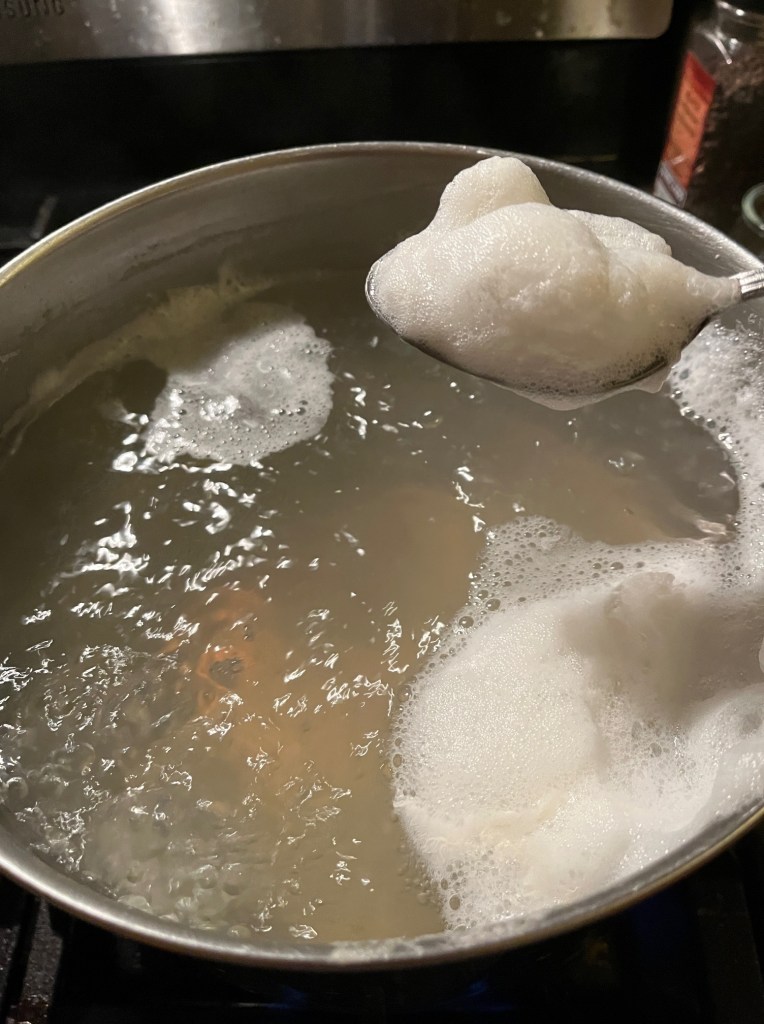
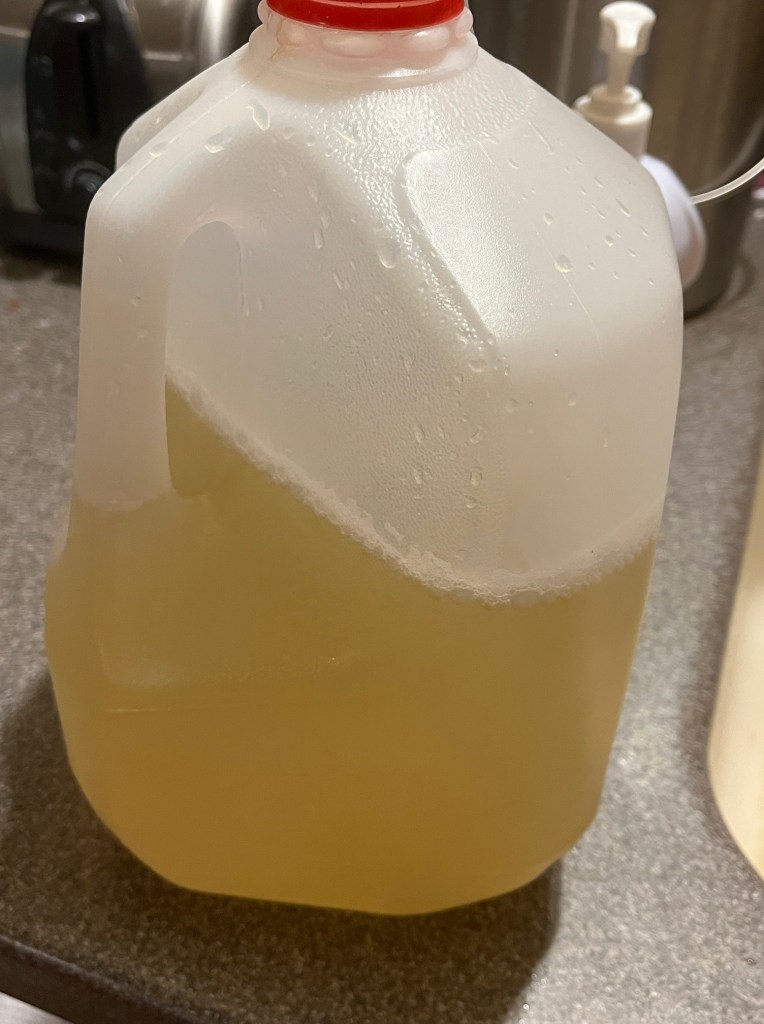
Circling back to where we started – I’m excited because I really relish the process. It’s the first interaction of the new year that I have with our yard’s chlorophyllic denizens. It starts even before I’ve started my veggie garden seedlings for the year. It forces me to pay attention to the weather, because sunny days mean more sap, and as a result I become more aware of the slow march of spring. I usually end up going and checking in on the collection jug 2-4 times a day; it’s a short walk, but any enforced time outdoors is a good thing for me at this time of year. A couple of times a week I boil the most recently collected sap about 75% of the way to syrup, as we have limited refrigerator space, the sap needs to be refrigerated to prevent it from spoiling, and I want to honor the gift and effort it represents. It’s a lot of effort and attention but there is a simple joy participating in the process and observing the changes that happen along the way.
Also, maple syrup is tasty.
I’ll report back at the end of the sugaring season on the results, assuming we don’t have some sort of syrup disaster in the meantime – and then it’ll be about time for me to make up my mind about what I want to start for the garden this year.
 Trash Panda Druiding
The way you describe nature contact as a genuine health stabilizer is something more people should say out loud. The relationship with the Norway maple is such a good exampl of urban ecology thinking, holding contradictions without forcing a resolution. Maple sugaring as the first real crack in winter’s grip is a lovely thing to look forward to. Hope the sap runs well this year!
LikeLike
Hey thanks! I’ll admit that my relationships with invasives has definitely evolved over the years, but working with what I’ve got (a small piece of land packed with a wide variety of natives and non-natives) has forced me to be more pragmatic in my thinking. I think possibly that leaning to live with contradictions and learning to be less dogmatic in my approach to gardening is probably really directly connected to some of the mental health benefits I see, and I suspect that’s true for others as well.
LikeLike